
‘Choice of Peace or War’: Xi Jinping, Flanked by Putin and Kim, Showcases Military Might on WWII Anniversary
China held its largest ever military parade in Beijing on Wednesday to mark the 80th anniversary of the end of World War II. President Xi Jinping delivered a speech that put the world at a crossroads between peace and war. The parade, held in Tiananmen Square, was not only a display of China’s growing military might, but also a symbolic statement of Beijing’s vision to reshape the global order.
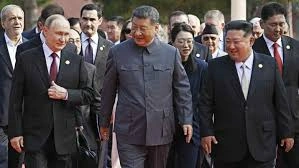
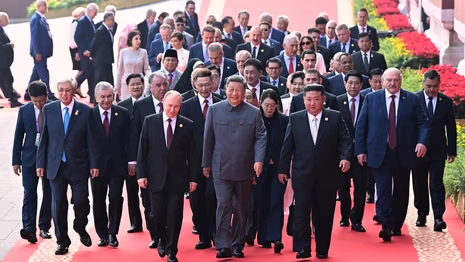
What made the event particularly significant was that besides Xi Jinping, many others were present. Russian President Vladimir Putin and North Korean leader Kim Jong Un—who the West has increasingly isolated—stood with China as guests of honor. Their presence underscored the shifting alliances at a time of rising global tensions and showed how Beijing seeks to strengthen ties with countries that oppose Western dominance.
A Historic Occasion in Tiananmen Square
The parade, attended by more than 50,000 spectators, was held to pay tribute to those who died in World War II as well as send a clear message about China’s current role in global geopolitics. Xi began his speech by paying tribute to the victims of the war and calling on the world to eradicate the root causes of conflict so that history does not repeat itself.
From the grandstand at Tiananmen Gate, Xi, Putin and Kim watched as troops of Chinese soldiers marched in step, their boots tapping rhythmically. Tanks passed, fighter jets flew overhead, and missile carriers showed off some of China’s most advanced weapons. The show of power made clear that Beijing is no longer content to remain a passive player in international security affairs.
The 80th anniversary of the end of the war provided the symbolic backdrop. For Xi, the commemoration links China’s wartime suffering and survival to his current narrative of “national rejuvenation,” in which the country has transformed from a victim of invasion to a global power demanding respect on the world stage.
Xi Jinping’s Warning to the World
Xi Jinping’s address at Tiananmen Square was as much about the present as it was about the past. Characterizing the world’s current moment as a turning point, Xi declared, “Today, mankind faces a choice between peace or war, dialogue or confrontation, win-win or zero-sum.”
The speech did not explicitly mention the United States, but its shadow loomed over the event. Xi’s comments were seen as a veiled critique of Western policies, especially in light of ongoing disputes with Washington over trade, technology and the global balance of power. By positioning China as a force for peace while also demonstrating its overwhelming military might, Xi attempted to craft a dual image: a responsible global power and a nation prepared to defend its interests.
He also thanked countries that helped China resist Japanese aggression during World War II, a move aimed at reminding the world of China’s sacrifices and contributions during one of history’s most devastating conflicts. However, the omission to mention the United States, especially given its role in defeating Japan, cannot go unnoticed.
A Parade of Military Power
The firepower display that followed Xi Jinping’s speech highlighted China’s growing capabilities. Modern fighter jets roared through the sky in a well-organized formation, demonstrating advances in stealth and aerial technology. Intercontinental ballistic missiles capable of reaching far-flung targets rumbled over the square, a visible sign of China’s deterrent capabilities.
Thousands of soldiers, dressed in striking uniforms, marched in unison with a precise choreography that exuded discipline and power. Each unit represented a different branch of the People’s Liberation Army, from the Army to the Navy. The event was carefully planned not just as a commemoration but also as a demonstration of China’s preparedness to both allies and rivals.
Observers noted that the size and sophistication of the parade far exceeded previous anniversaries, reflecting China’s ambition to modernize its armed forces and rival the military might of the West. For many in Beijing, the parade was proud evidence that China had overcome a century of humiliation to become an indispensable player in global affairs.
Vision for a New Global Order
Xi Jinping framed World War II as a defining turning point in China’s trajectory. He described the conflict as a crucible in which China emerged from the devastation of Japanese invasion to begin a path toward becoming an economic and geopolitical powerhouse. This narrative dovetails with Xi’s broader theme of the “great rejuvenation of the Chinese nation,” a phrase he has used frequently to emphasize China’s return to prominence.
The military parade thus doubled as a message about the future world order. Xi’s remarks suggested that China sees itself as a leader in shaping a system that rejects zero-sum competition in favor of multipolar cooperation. However, by standing shoulder to shoulder with leaders like Putin and Kim, Beijing also signaled that it is willing to align with those who share its opposition to Western influence, even at the cost of further alienating Europe and the United States.
Amid rising tensions over Taiwan, the South China Sea, and global trade disputes, Xi’s message appeared aimed at consolidating China’s alliances and reminding adversaries of the risks of confrontation.
The Guests of Honor: Putin and Kim
Perhaps the most striking element of the commemoration was the presence of Russian President Vladimir Putin and North Korean leader Kim Jong Un. Both men are considered pariahs by much of the West due to Russia’s invasion of Ukraine and North Korea’s persistent nuclear brinkmanship. Their attendance signaled that Beijing is not only willing to embrace them but also willing to showcase these relationships on the world stage.
Xi greeted both leaders personally as they arrived at Tiananmen Gate, shaking hands and escorting them to the viewing platform. The optics were unmistakable: China was positioning itself as a central hub for a new coalition of powers resistant to U.S. influence.
For Putin, the event provided a chance to display international legitimacy at a time when Russia faces sanctions and isolation. For Kim, it was an opportunity to stand alongside two of the world’s most powerful leaders, strengthening North Korea’s relevance. For Xi, it demonstrated China’s ability to convene and host figures whom the West prefers to marginalize.
Trump’s Response and Western Reactions
While Western leaders largely ignored the Beijing parade, U.S. President Donald Trump offered his own commentary from afar. On Truth Social, he posted a message that blended sarcasm with criticism, writing: “Please give my warmest regards to Vladimir Putin, and Kim Jong Un, as you conspire against The United States of America.” The remark was widely seen as an attempt to downplay the significance of the event while simultaneously drawing attention to the unusual trio of leaders standing together in Beijing.
Trump also questioned whether Xi would acknowledge the contributions of American soldiers who fought in World War II, hinting at the political sensitivities around historical memory. At the same time, he insisted that he did not view the parade as a direct challenge to the United States, emphasizing his “very good relationship” with Xi despite rising tensions.
The muted response from European leaders underscored the growing divide between China and the West. By boycotting the parade, they avoided lending legitimacy to an event that prominently featured two leaders widely condemned on the international stage.
Symbolism and Strategic Messaging
The Beijing parade was as much about symbolism as it was about military technology. By pairing the solemn commemoration of World War II with a massive show of force, China sought to remind the world of its resilience and its readiness for the future. The message to its citizens was one of pride and confidence; the message to the outside world was a warning not to underestimate Beijing’s resolve.
The choice of guests reinforced this symbolism. Putin and Kim’s presence amplified the sense of a shifting geopolitical alignment, one where China is carving out an alternative to Western-led systems. At the same time, Xi’s careful avoidance of direct mention of the United States reflected a desire to project strength without provoking an immediate escalation.
For China, the parade marked not only a milestone in remembering history but also a declaration of intent about the future it envisions—one where Beijing plays a central role in defining the terms of peace, power, and cooperation.
Final Word
The 80th anniversary of World War II’s end was meant to honor the sacrifices of the past, but in Beijing it became equally about the battles of the present and the ambitions for the future. Xi Jinping’s choice to frame the moment as one between peace or war, dialogue or confrontation, reveals the stakes he sees in today’s world order.
The presence of Vladimir Putin and Kim Jong Un at his side underscored both the opportunities and risks of China’s current path. While the parade projected power and unity among these leaders, it also sharpened divisions with the West. In this delicate balance, the world must watch closely to see whether the emphasis on peace can prevail over the looming shadows of confrontation.
Click Here to subscribe to our newsletters and get the latest updates directly to your inbox.