
‘Will Always Be Friends with Modi’: Trump Softens Tone After ‘Lost India to China’ Remark
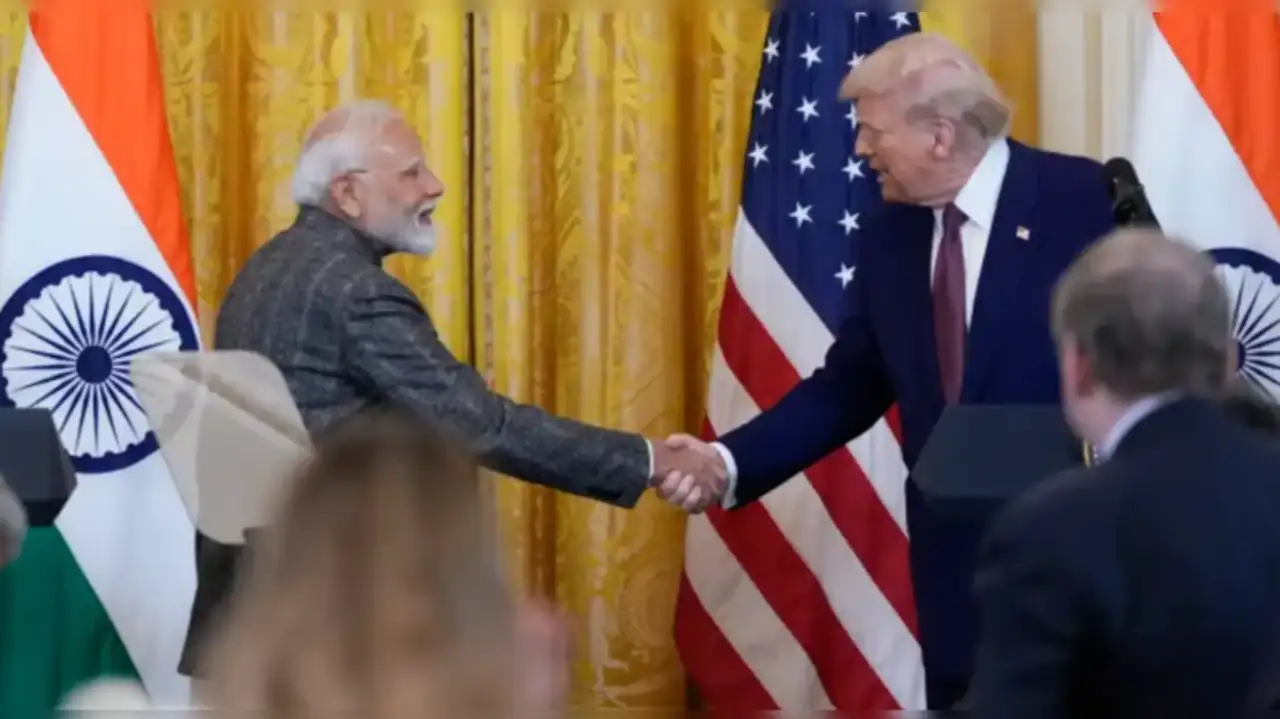
US President Donald Trump on Friday sought to calm concerns about a potential rift in Washington’s relationship with India, downplaying tensions a day after his remarks that the United States had “lost India and Russia to China.” Speaking to reporters in the Oval Office, Trump described US-India ties as “special” and reaffirmed his friendship with Prime Minister Narendra Modi.
“I’ll always be friends with Modi, he’s a great prime minister. He’s great. I’ll always be friends, but I just don’t like what he’s doing at this particular moment,” Trump said, smiling as he responded to questions about whether he was looking to reset ties with New Delhi. “There’s nothing to worry about. We just have moments on occasion.”
His reassurance appeared designed to smooth over the controversy sparked by his earlier post on Truth Social, where he declared that America had “lost India and Russia to deepest, darkest China,” a comment that raised eyebrows in diplomatic circles.
Disappointment Over Russian Oil Purchases
Despite his conciliatory tone, Trump expressed disappointment with India’s continued imports of Russian oil amid the ongoing Ukraine conflict. “I’ve been very disappointed that India would be buying so much oil from Russia, and I’ve let them know—with the 50 per cent tariff,” he said.
The President’s comments came after his administration recently slapped tariffs totaling 50 percent on Indian goods—25 percent announced in late July and another 25 percent specifically targeting India’s Russian oil purchases earlier in August.
Trump insisted that his objection is not to India’s leadership but to its policies. “I get along very well with Modi, as you know. He was here a couple of months ago. We went to the Rose Garden,” Trump added, underscoring his personal ties to the Indian Prime Minister.
The Social Media Storm: ‘Lost India to China’
The controversy began on Thursday, when Trump posted on his Truth Social platform: “Looks like we’ve lost India and Russia to deepest, darkest, China. May they have a long and prosperous future together! President Donald J. Trump.”
Accompanying the post was an old photograph of Modi with Russian President Vladimir Putin and Chinese President Xi Jinping, taken at a past trilateral meeting. The timing of Trump’s message coincided with Modi’s attendance at the Shanghai Cooperation Organisation (SCO) summit in Tianjin, China, where he held bilateral meetings with both Xi and Putin.
Observers saw Trump’s post as a reaction to the visible camaraderie displayed between Modi, Xi, and Putin at the gathering. The imagery fueled speculation that Washington feared a tightening bond between India, Russia, and China, three powers that form a key bloc within the SCO.
India’s Response: Oil Purchases Driven by Economics
India, for its part, has maintained that its energy policy is guided by national interest, not geopolitics. Finance Minister Nirmala Sitharaman addressed the issue directly on Friday, stressing that New Delhi will continue to buy oil from Moscow.
“Whether it is Russian oil or anything else, it’s our decision to buy from the place which suits our needs… So, where we buy our oil from…we will have to take a call which (supply source) suits us the best. So, we will undoubtedly be buying it,” Sitharaman said in an interview with CNN-News18.
She also dismissed Washington’s allegations that India’s purchases were indirectly funding Moscow’s war effort, emphasizing that India’s decisions were aimed at shielding its citizens from inflationary pressures and contributing to stability in global energy markets.
New Delhi has repeatedly pointed out that other major buyers, including China and European nations, continue to import Russian energy without facing similar penalties. The Finance Minister described the US tariffs as “unjustified,” signaling India’s firm rejection of Washington’s criticism.
Trade Advisor’s Harsh Words Add to Tension
Adding fuel to the fire, Trump’s trade advisor Peter Navarro recently escalated rhetoric by labeling the Ukraine conflict “Modi’s war,” accusing India of being an “oil money laundromat for the Kremlin.” His comments drew sharp reactions in New Delhi, where officials dismissed the claim as inflammatory and disconnected from economic realities.
While the Trump administration continues to tie India’s energy purchases to geopolitical considerations, Indian officials insist that affordability and supply security remain their top priorities. With global oil markets volatile and energy costs weighing heavily on developing economies, India argues that it cannot afford to forgo favorable deals from Russia.
The SCO Summit: Symbolism and Reality
Prime Minister Modi’s visit to Tianjin was his first to China in seven years, marking a notable diplomatic moment. At the Shanghai Cooperation Organisation summit, Modi engaged in meetings not only with Xi Jinping and Vladimir Putin but also with leaders from Central Asian states.
For New Delhi, the trip was an opportunity to showcase its multi-aligned foreign policy—maintaining ties with both Western powers and Eurasian partners. Indian officials underlined that the engagement at the SCO did not represent a strategic pivot toward Beijing or Moscow but rather reflected the importance of regional cooperation.
Still, the optics of Modi standing alongside Xi and Putin proved politically potent, fueling speculation in Washington that India could be drifting away from its partnership with the United States. Trump’s Truth Social post appeared to capture that anxiety, even as his later remarks sought to walk it back.
Balancing Act: India Between Washington and Moscow
India has long walked a careful line in its foreign policy. While deepening strategic ties with Washington through defense pacts, trade agreements, and joint military exercises, New Delhi has maintained robust relations with Russia, its traditional defense supplier and a key energy partner.
The war in Ukraine has made this balancing act more complex. Washington has pressed allies and partners to reduce dependence on Russian energy and arms, while India has expanded its imports of discounted Russian oil to meet domestic needs. The decision has at times strained New Delhi’s relations with Washington, even as both sides continue to emphasize the importance of their broader strategic partnership in the Indo-Pacific.
Trump’s Recalibration and Future Outlook
Trump’s softer tone on Friday suggests an awareness of the risks of alienating India at a time when Washington views New Delhi as a crucial partner in counterbalancing China. By highlighting his personal rapport with Modi and describing India as a “special” friend, Trump sought to project continuity in the bilateral relationship despite ongoing disputes.
Still, the imposition of steep tariffs, coupled with sharp public criticism, signals that economic tensions will remain a flashpoint. For India, the challenge will be to navigate between maintaining its sovereignty in foreign policy decisions and avoiding the escalation of a trade conflict with its most important Western partner.
As the geopolitical landscape evolves, the coming months will reveal whether Trump’s administration pursues a harder line on India’s Russian oil imports or seeks compromise to preserve strategic alignment in the Indo-Pacific.
Closing Line
While Trump’s rhetoric oscillates between sharp criticism and warm reassurances, the core of the US-India relationship remains intact. For both Washington and New Delhi, the test lies in managing differences over Russia without undermining a partnership seen as vital in an era of great-power rivalry.
Click Here to subscribe to our newsletters and get the latest updates directly to your inbox.