
Police Detain London Demonstrators Supporting Banned Group Palestine Action
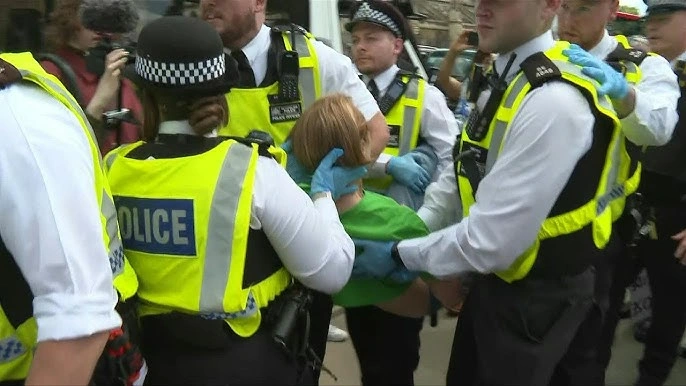
Tensions flared in central London on Saturday as police clashed with demonstrators defying a ban on the activist group Palestine Action, which the UK government has designated as a terrorist organization. The protest, organized by the campaign network Defend Our Juries, drew an estimated 1,500 people to Parliament Square, many holding placards that read “I oppose genocide, I support Palestine Action.”
Within minutes of the gathering, Metropolitan Police officers began making arrests, dragging away participants who refused to move and went limp in acts of passive resistance. The arrests sparked chants of “Shame on you” and “Met Police, pick a side, justice or genocide” from bystanders. By the end of the evening, police confirmed that about 150 people had been arrested, including several on charges of assault.
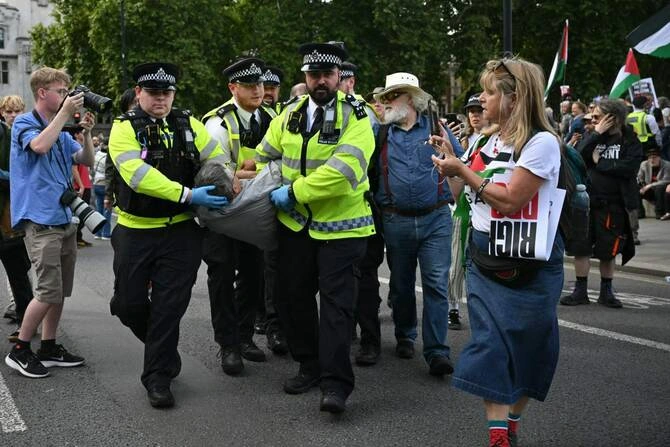
The demonstration is the latest in a series of confrontations between British authorities and Palestine Action supporters, who have continued to mobilize despite the risks of prosecution under the Terrorism Act.
Legal Grounds for Arrests Under Terrorism Law
In a statement on social media, the Metropolitan Police justified the mass detentions. “Expressing support for a proscribed organization is a criminal offence under the Terrorism Act. Where our officers see offences, we will make arrests,” the force wrote.
Under British law, groups listed as proscribed organizations cannot be supported, endorsed, or promoted in any public capacity. Violating the ban carries penalties of up to 14 years in prison. While hundreds of people have been detained at earlier demonstrations, this latest protest marks one of the largest single-day crackdowns, bringing the total number of arrests linked to Palestine Action to more than 700, with 138 individuals already charged.
The arrests have prompted an outcry from civil liberties advocates, who argue the government is misusing counterterrorism laws to criminalize dissent and suppress political activism.
Personal Stories from the Protest
Among those arrested on Saturday was Mike Higgins, a 62-year-old activist who is blind and uses a wheelchair. Higgins, who had already been arrested last month under the Terrorism Act, expressed defiance before being taken away once again.
“And I’m a terrorist? That’s the joke of it,” he told reporters. “I’ve already been arrested under the Terrorism Act and I suspect I will be today. Of course I’ll keep coming back. What choice do I have?”
Higgins’ case illustrates how ordinary citizens, including those with disabilities, have been caught up in the escalating crackdown. Protesters argue their actions are motivated by moral opposition to Britain’s role in supplying arms to Israel, not by violence or terrorism.
The Ban on Palestine Action
The UK government moved to proscribe Palestine Action in July 2025, citing national security concerns. The decision followed a dramatic incident in which activists broke into a Royal Air Force base, vandalized two tanker planes by spraying red paint into their engines, and caused further damage with crowbars.
Authorities said the raid endangered national security and cost millions in damages. Then-Home Secretary Yvette Cooper described the group as violent and disruptive, stressing: “The assessments are very clear, this is not a nonviolent organization.”
Since its founding in 2020, Palestine Action has gained notoriety for its direct action tactics. Members have repeatedly targeted Elbit Systems UK, the British arm of Israel’s largest defense company, as well as other sites linked to the arms trade. Activists have broken into factories, defaced offices, and staged blockades at sites supplying weapons to Israel, causing significant disruption.
Court Battles and Free Speech Debate
The ban has not gone unchallenged. Palestine Action has secured permission from the High Court to contest its designation as a terrorist organization. A full hearing is scheduled for September 25, though the government is actively seeking to overturn the group’s legal appeal.
Civil liberties advocates argue the proscription sets a dangerous precedent by equating political activism with terrorism. UN human rights chief Volker Türk has publicly criticized the UK government, warning that the decision “misuses the gravity and impact of terrorism.” Türk emphasized that under international standards, terrorism should be confined to acts intended to cause death, serious injury, or hostage-taking, not property damage or political expression.
Supporters of Palestine Action fear the ruling will have a chilling effect on free speech. Co-founder Huda Ammori condemned the move as “catastrophic” for civil liberties in Britain. “This ban is not just about Palestine Action, it’s about silencing anyone who dares to stand against state complicity in genocide,” she said.
Cultural Figures Rally Behind Activists
The crackdown on Palestine Action has also drawn attention from prominent cultural figures. Irish novelist Sally Rooney, author of several international bestsellers, voiced her solidarity with the group, pledging to donate proceeds from her work to support direct action against what she described as genocide in Gaza.
Rooney’s support underscores the widening debate in cultural and intellectual circles over Britain’s stance on the Israeli-Palestinian conflict. While critics accuse the government of stifling dissent, ministers insist that proscription does not target lawful activism and only applies to organizations deemed dangerous to public order and security.
Broader Context: Gaza Conflict and UK’s Role
The controversy around Palestine Action cannot be separated from the ongoing war in Gaza, where Israel has faced international criticism over its military campaign against Hamas. Activists accuse Britain of enabling the offensive by allowing weapons manufacturers such as Elbit Systems to operate freely in the UK.
The government rejects accusations of complicity, framing its ban on Palestine Action as part of a broader strategy to protect national security and prevent costly sabotage of defense infrastructure. Officials insist that the proscription does not prevent peaceful expressions of solidarity with Palestinians or lawful criticism of Israel’s policies.
Nonetheless, the arrests in London highlight a growing rift between grassroots movements calling for radical action and state institutions seeking to draw a hard line against disruptive protest.
International Criticism and Human Rights Concerns
Internationally, Britain’s actions have come under scrutiny. The UN’s sharp rebuke has been echoed by several human rights organizations, who warn that the criminalization of protest risks undermining democracy itself.
By conflating direct action with terrorism, critics argue, the UK risks delegitimizing peaceful civil disobedience and restricting the right to protest. They also caution that the new approach could set a precedent for other governments to label activist groups as terrorists, effectively shutting down dissent.
At the same time, supporters of the ban emphasize the economic and security impact of Palestine Action’s tactics, which they say have caused millions in damages and placed military assets at risk. For them, the government’s decision is a necessary step to protect vital infrastructure.
Closing Line
The arrests in London illustrate the deepening conflict between the UK government’s counterterrorism agenda and growing public demands for accountability over Britain’s role in the Gaza war. As Palestine Action prepares its High Court challenge later this month, the outcome will shape not only the future of the group but also the boundaries of free expression in Britain.
Click Here to subscribe to our newsletters and get the latest updates directly to your inbox.