
Fires, Barricades and 200 Arrests: ‘Block Everything’ Protests Sweep Across France
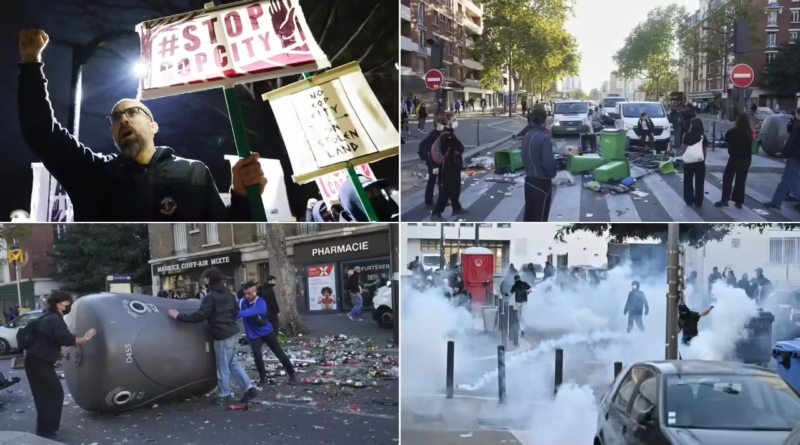
France descended into another day of turmoil on Wednesday as ‘Block Everything’ protests swept across major cities, turning streets into battlegrounds. Demonstrators blocked roads, set fires, and clashed with police who responded with tear gas in several locations, including the capital Paris.
The unrest comes just days after President Emmanuel Macron appointed his new prime minister, Sébastien Lecornu. The timing of the protests appears deliberate, as opposition groups sought to give Macron’s government what they called an “immediate trial by fire.”
The demonstrations reflect the anger building across the country over Macron’s policies and reforms, with unions, leftist groups, and youth organizations rallying to disrupt normal life in a show of defiance.
Interior Minister Confirms 200 Arrests
French Interior Minister Bruno Retailleau confirmed that nearly 200 arrests had already been made in the opening hours of the protests. He described the unrest as a calculated effort to destabilize the country and warned that the authorities would respond firmly.
Retailleau detailed several violent incidents that highlighted the escalating situation. A bus was torched in Rennes, while damage to a major power line disrupted train services in the southwest of the country. “What we are seeing is an attempt to create a climate of insurrection,” he told French media, calling the attacks on infrastructure “irresponsible and dangerous.”
The Interior Minister also confirmed that additional riot police had been deployed across Paris and other hotspots to contain the unrest.
Fires and Barricades in Paris and Beyond
In Paris, central boulevards were filled with the smoke of burning barricades as protesters clashed with security forces. Makeshift fires were lit using trash bins, scooters, and construction debris, creating chaotic scenes. Police units fired rounds of tear gas and used water cannons to disperse crowds attempting to march toward government buildings.
Similar scenes were reported in Rennes, Nantes, Lyon, and Toulouse, where groups of protesters blocked key highways and set up barricades. Reports also emerged of attacks on police vehicles and vandalism of public property.
For many in France, these protests signal the return of the kind of disruptive street action that the country witnessed during the Yellow Vest movement, which brought Macron’s government under immense pressure in previous years.
Macron’s New Prime Minister Faces Immediate Trial
The protests are being seen as the first major test for Macron’s newly appointed Prime Minister, Sébastien Lecornu, who replaced François Bayrou after disputes over the 2026 budget plan. Lecornu, a close ally of Macron, is tasked with delivering reforms while navigating a deeply divided political climate.
Opponents argue that Macron’s government is out of touch with working-class realities, pointing to rising living costs, economic inequality, and controversial policies such as the retirement age increase. Protesters say that Lecornu’s appointment represents continuity rather than change, fueling their anger further.
By launching the “Block Everything” movement just days after Lecornu’s nomination, organizers are making clear that the new government will not be given a grace period. Instead, it faces a trial by fire from day one.
Disruption to Daily Life
The protests have already caused major disruptions to daily life. In Rennes, the torching of a bus forced authorities to suspend public transport services in parts of the city. The attack on a power line in the southwest delayed several regional trains, affecting thousands of commuters.
Businesses in affected areas were forced to close their doors as clashes erupted outside. In Paris, shops in central districts pulled down shutters early as smoke filled the streets. Schools and universities in protest zones also reported lower attendance as parents kept children home for safety.
The economic toll of these demonstrations is expected to be significant if they continue, adding further strain to France’s already fragile budgetary position.
Police and Protester Clashes Intensify
Eyewitnesses described the clashes between police and protesters as some of the fiercest seen in months. Riot police in full gear formed lines to prevent crowds from advancing, while protesters hurled stones, bottles, and fireworks.
Videos circulating on social media showed protesters chanting slogans against Macron and Lecornu while waving red flags and banners demanding the repeal of unpopular reforms.
The use of tear gas and water cannons in Paris sparked outrage among some activists, who accused the government of heavy-handed tactics. Police unions, on the other hand, defended the response, saying their officers were facing “unprecedented levels of violence.”
Political Stakes for Macron
The timing of the protests could not be worse for Macron, who is seeking to push ahead with his economic reform agenda. With a minority government in parliament, Macron already relies on delicate political alliances, including tacit cooperation from far-right groups.
The eruption of protests risks undermining Lecornu’s ability to deliver the 2026 budget agreement, a critical step for controlling France’s soaring deficit, which currently stands at nearly twice the EU’s recommended limit of 3% of GDP.
Opposition leaders wasted no time seizing on the protests to attack Macron’s administration. Leftist parties accused the government of ignoring the struggles of ordinary citizens, while far-right leader Marine Le Pen said the unrest was a clear sign that Macron had lost control.
A Nation on Edge
For many ordinary French citizens, the sight of burning barricades and clashes with police is an unsettling reminder of the country’s volatile protest culture. France has long been a nation where street demonstrations shape political outcomes, but the intensity of the latest unrest is alarming even by French standards.
Analysts say the government faces a difficult balancing act—responding firmly to maintain law and order, while also avoiding measures that could further inflame public anger.
If the protests continue to escalate, they could weaken Macron’s position both at home and abroad, especially as France plays a central role in European politics.
Block Everything’ protests
The ‘Block Everything’ protests in France represent more than just isolated acts of dissent—they mark a broader crisis of confidence in Macron’s leadership and his new prime minister’s ability to deliver stability. With fires burning in Paris, buses torched in Rennes, and nearly 200 arrests already recorded, the country is entering a period of heightened political and social tension.
Whether Macron and Lecornu can weather this storm remains uncertain, but one thing is clear: the protests have sent an unmistakable message that France’s streets remain as powerful as its parliament in shaping the nation’s future.
Click Here to subscribe to our newsletters and get the latest updates directly to your inbox.