
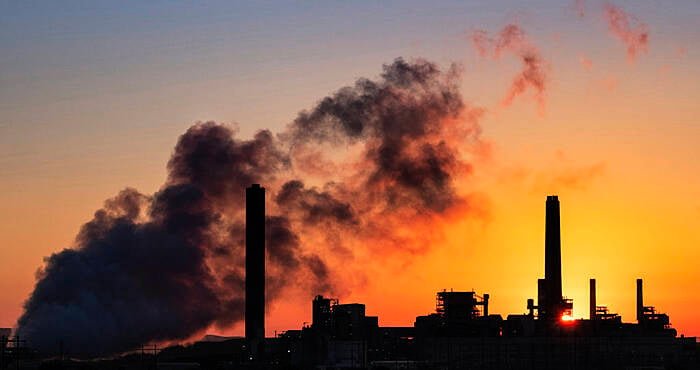
China Announces Its First Emission Cut Targets, Promises 7–10 % Reduction by 2035
In a highly publicized move at the UN Climate Summit, China has announced its first full emissions reduction target: a pledge to reduce greenhouse gas emissions by 7 to 10 percent from their peak levels by 2035.
Until now, China’s public climate targets have focused on reducing emissions intensity—that is, the amount of emissions per unit of gross domestic product. While this approach slows the rate of pollution growth, it does not necessarily reduce the total amount of emissions, which continue to rise in absolute terms.
The newly announced target marks a change in tone and ambition. Since China is responsible for more than 30% of global carbon dioxide emissions, this move is of significant international significance.
What Exactly Did China Announce?
In a video address to a UN climate change event, President Xi Jinping announced that China will aim to reduce greenhouse gas emissions from its economy by 7-10 percent from their peak levels by 2035.
Along with this goal, Xi Jinping also committed to increasing China’s wind and solar power capacity more than sixfold from 2020 levels and increasing the share of non-fossil fuels in total energy consumption to more than 30% by 2035.

These measures demonstrate that China plans not only to slow emissions growth but also to shift its energy mix toward cleaner sources. However, critics argue that this 7-10% figure is modest compared to what climate scientists say is needed to limit global warming.
Why This Shift Matters
This is the first time China has committed to absolute emission reductions rather than reducing emission intensity. This distinction matters: intensity targets can allow emissions to continue rising while becoming more “efficient.” With this move, China is signaling its new willingness to reduce actual quantities.
Since China is the world’s largest emitter of greenhouse gases, any reductions it makes will have a huge impact on global climate goals. If this target is achieved, it could inspire other major emitters to adopt more ambitious plans.
But some observers caution that China’s pledge still falls short of the scale of reductions many climate scientists say are needed. China could still fall short of the deep cuts needed to keep the Earth’s temperature rise within safe limits.
Challenges on the Road Ahead
Setting targets is one thing; achieving them is quite another. China faces serious structural and economic challenges that could hinder its progress.
Coal remains the core of China’s energy system, providing a significant portion of electricity and heating, especially in less developed regions. Reducing coal dependence while maintaining a stable power supply will require significant investment and careful planning.
Improving industrial processes, modernizing older plants, and expanding renewable energy in provinces with varying capacity levels will require coordination and resources. Coal-dependent regions may resist this shift due to job losses and economic disruptions.
Another challenge is policy credibility. Although China has a history of meeting or exceeding many of its environmental targets, the gap between rhetoric and action is often criticized. Analysts will be closely monitoring whether this announcement translates into concrete regulation, enforcement, and financing.
Comparison with Past Climate Commitments
Previously, China’s climate pledges focused on peaking emissions by 2030 and improving energy efficiency and carbon intensity metrics.
Those pledges aligned with the Paris Agreement’s call for Nationally Determined Contributions (NDCs), where countries voluntarily set their reduction goals. But until now, China had avoided committing to cuts in absolute emissions, instead promising that its emissions would plateau and then decline over time.
With this new announcement, China is effectively upgrading its climate ambition by setting a reduction floor beyond its expected peak.
Global Reactions and Expectations
Leaders and climate watchers responded swiftly. Some praised China’s move as a meaningful step toward global climate responsibility, while others warned it was still insufficient given the scale of the crisis.
Critics say that to limit warming to 1.5 °C, deep cuts—often well beyond 20–30 % in decades—are necessary from major emitters. They caution that China’s target, though symbolic, may be too conservative.
Others point to China’s ability to overdeliver: historically, when China sets modest goals, its actual achievements have sometimes exceeded them. That track record gives room for cautious optimism.
Internationally, pressure will now build on other major emitters—such as the U.S., India, and the EU—to match or surpass China’s new target.
What Will Determine Success
For China to meet this pledge, several factors will be critical:
First, strong regulatory mechanisms and enforcement. Without strict oversight, regions or sectors could underperform or delay transitions.
Second, financial investment. The scale of clean energy deployment, grid modernization, storage, and carbon capture will require massive public and private funding.
Third, technological innovation. Improvements in renewable efficiencies, energy storage, low-carbon industrial processes, and carbon removal solutions will play an essential role.
Fourth, local alignment. Because China’s provinces have significant power over energy policy, ensuring that local governments buy in — economically and politically — is key.
Finally, international cooperation. China may need technology transfer, green finance, and collaboration to scale clean infrastructure.
Table: China’s New Climate Commitments at a Glance
| Commitment | Stated Target | Timeframe | Notes |
|---|---|---|---|
| Emissions reduction | 7 to 10 % cut from peak | By 2035 | First absolute emissions target |
| Non-fossil fuel share | Over 30 % of energy mix | By 2035 | Increase clean energy share |
| Wind & solar capacity | 6× (six times) 2020 levels | By 2035 | Massive scale-up planned |
Significance for India and the Global South
China’s new target matters to India and other developing nations in multiple ways. Its shift to cleaner energy and absolute emissions reductions may ease some global pressure on developing countries to move faster. It also sets a precedent: if the largest developing emitter can commit to actual cuts, others may feel encouraged to follow.
However, India must chart its own path based on its development needs, poverty pressures, and energy access goals. China’s move does not relieve India of responsibility, but it does change the diplomatic and climate context in which India must negotiate.
Conclusion
China’s announcement of a 7–10 % emissions cut by 2035 marks a turning point in global climate diplomacy. For the first time, the world’s largest emitter has committed to reducing absolute emissions, not merely curbing intensity. While the target may not satisfy the most ambitious climate advocates, it signals that China is willing to shoulder more responsibility in the low-carbon transition.
The real test, however, lies ahead. If China follows through with strong policies, investment, enforcement, and local compliance, this pledge could reshape global climate leadership and expectations.
Click Here to subscribe to our newsletters and get the latest updates directly to your inbox