
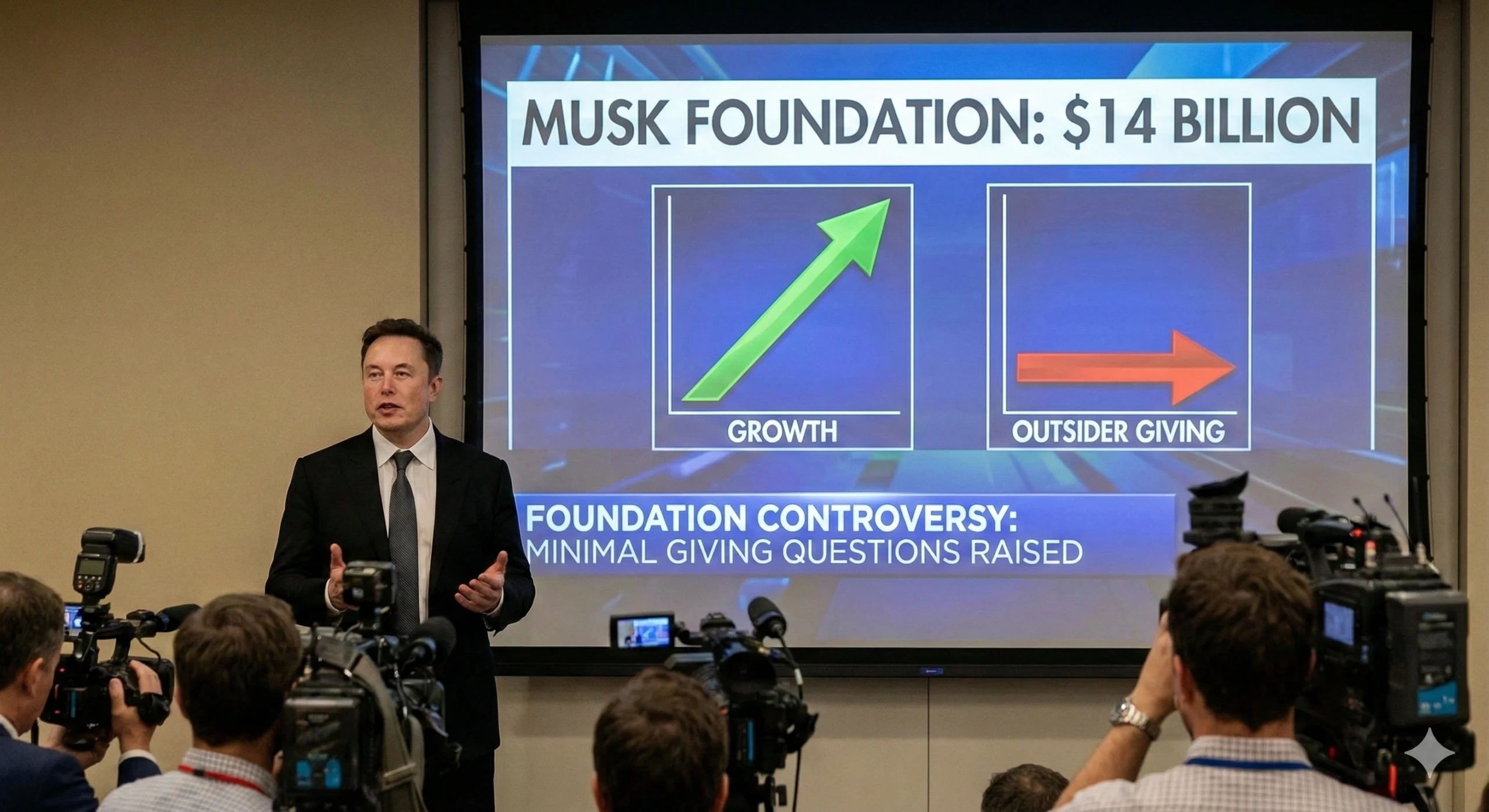
Elon Musk’s $14 Billion Foundation: Massive Growth, Minimal Outsider Giving Sparks Controversy
Elon Musk’s charitable empire reached unprecedented scale in 2024, ballooning to over $14 billion in assets and becoming one of America’s largest private foundations. Yet this windfall—largely from 18 million donated Tesla shares—has fueled criticism rather than widespread benevolence. For the fourth consecutive year, the Musk Foundation failed to meet the IRS-mandated 5% annual distribution requirement, and when it did give, over 75% of its record $474 million in grants flowed to nonprofits tightly linked to Musk’s personal and business interests. These revelations come straight from the foundation’s 2024 tax filing, obtained by The New York Times, painting a picture of philanthropy that critics call more self-serving than society-serving.
Musk, the world’s richest person with a net worth exceeding $400 billion, has long positioned himself as a pragmatic giver struggling with “effective altruism.” In a recent podcast with Nikhil Kamath, he lamented the challenge: “It’s very easy to give money away to get the appearance of goodness. It is very difficult to give money away for the reality of goodness.” He even claimed anonymity for his foundation—despite its namesake branding since 2001. But tax documents tell a different story: a lean operation run by three unpaid volunteers (Musk, family office head Jared Birchall, and an aide logging just six minutes weekly), a bare-bones website untouched for years, and giving patterns that mirror Musk’s companies rather than broad humanitarian needs.
Record Giving, But Mostly to Musk’s Inner Circle
The foundation disbursed $474 million in 2024—its highest ever—but the recipients raise eyebrows. The lion’s share, $370 million (78%), went to “The Foundation,” a Texas nonprofit helmed by Musk’s top aide operating a STEM-focused elementary school in rural Bastrop County. This area hosts clusters of Musk enterprises like Tesla’s gigafactory and xAI facilities, where many employees reside. Since 2022, cumulative gifts to this entity total $607 million, with ambitions for a high school and eventual university. Critics question if this qualifies as charity or employee perk disguised as philanthropy.
Another $35 million landed in a Fidelity donor-advised fund (DAF)—a vehicle where donors retain advisory control over distributions. Musk’s filings explicitly note retained influence, meaning these assets could sit indefinitely or flow back to preferred causes. The remaining ~$69 million scattered to SpaceX-adjacent South Texas community groups (post-2021 rocket explosion), Austin-area causes near Musk’s residence, $5 million to his son’s alma mater Windward School in LA, and Jewish organizations amid antisemitism accusations leveled at Musk/X.
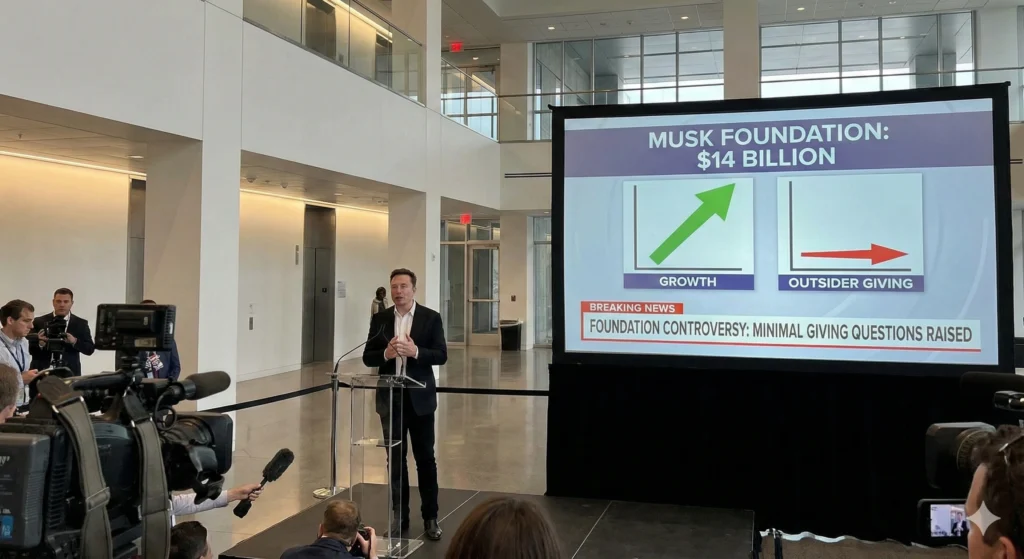
This concentration marks 2024 as the highest proportion of “connected” giving since 2020, per Times analysis. Contrast with peers: Bill Gates’ foundation deploys billion-dollar teams tackling global health; MacKenzie Scott scatters hundreds of millions broadly. Musk’s model? Concentrated, controlled, business-aligned.
IRS Minimums Missed—Again—and Penalties Loom
Private foundations must distribute 5% of average assets annually or face escalating IRS penalties (up to 100% of shortfall). Musk’s foundation fell short in 2021-2023, entering 2024 owing $421 million from prior deficits. It cleared that backlog—mostly via The Foundation transfer—but still shorted $393 million on 2024’s requirement. Deadline? End of 2025, perpetuating the cycle. This “qualified distributions” loophole lets foundations defer indefinitely by shifting to DAFs or affiliates without true societal impact.
Tesla stock appreciation supercharged growth: from $9.5B in 2023 (per earlier filings) to $14B+ now. Donated shares yield Musk massive tax deductions while assets compound tax-free. Yet minimal staff—no grantmaking teams, evaluators, or outreach—suggests disinterest in scaling impact. Compare to Silicon Valley Community Foundation’s $4.7B grants on $13.6B assets.
Musk’s Philanthropy Philosophy: Effective or Elitist?
Musk frames his approach as rigorous: rejecting “feel-good” giving for measurable outcomes. Ad Astra (early The Foundation precursor) educated his kids alongside promising talents. X Prize Foundation grants (prior recipient) spur innovation aligning with SpaceX/Tesla goals. Yet concentration raises red flags—does employee-area schooling truly serve humanity, or retain talent in Musk’s ecosystem?
Musk’s podcast gripes ring hollow against peers’ scale. He’s given ~$559M over three years—generous absolutely, modest relatively. No response to NYT/Bloomberg queries fuels speculation: tax strategy over altruism? DAFs, popular among billionaires, enable perpetual control; Musk’s Fidelity/Vanguard infusions total $140M+ since 2016, destinations opaque.
Business Synergies: Charity as Corporate Tool?
Patterns emerge: Bastrop school amid Tesla/xAI boom; South Texas gifts post-SpaceX mishap; Austin donations where Musk resides. Windward aids family; Jewish causes counter PR woes. This isn’t random—it’s ecosystem support. Foundations legally can’t directly benefit donors, but “related” entities skirt edges. IRS scrutiny? Rare for mega-donors.
The Foundation’s IRS application touts university ambitions—echoing Musk’s Mars colonization vision? STEM focus mirrors Neuralink/Tesla needs. Philanthropy becomes talent pipeline, community stabilizer for company towns.
Comparisons: Musk vs. Billionaire Peers
| Foundation | 2024 Assets | 2024 Giving | Key Focus | Staff Size |
|---|---|---|---|---|
| Musk Foundation | $14B+ | $474M (78% connected) | Business-aligned education | 3 volunteers |
| Gates Foundation | $75B | ~$7B | Global health | 2,000+ |
| SV Community Foundation | $13.6B (2023) | $4.7B | Broad grants | Large teams |
| Ford Foundation | $16B | ~$600M | Social justice | 500+ |
Musk’s lean model contrasts peers’ infrastructure. No marketing, no impact reports—philanthropy stays obscure, like Musk claims.
Broader Implications: Tax Policy, Philanthropy Reform
Musk’s case spotlights U.S. foundation loopholes. 5% rule dates to 1976; critics push hikes to 10%+. DAFs explode—$230B assets, minimal disclosure. Musk embodies “donor control” critique: tax breaks without societal payout.
Politically active Musk (DOGE co-head under Trump) invites scrutiny. Does foundation influence policy? Jewish gifts amid X controversies suggest reputation management.
Perpetual Deferral or Genuine Expansion?
Musk faces 2025 deadline for $393M shortfall. Expect more The Foundation/Fidelity flows. University launch could justify scale—if truly open. Otherwise, pattern persists: grow assets, minimize outflows, maximize control.
For observers/devs: Track via ProPublica Nonprofit Explorer. Build dashboards (React/Tailwind) parsing 990-PFs. Musk’s model challenges “effective altruism”—impact or insulation?
$14B war chest demands reckoning. Musk seeks “reality of goodness”—2024 suggests business reality prevails.
Click Here to subscribe to our newsletters and get the latest updates directly to your inbox