
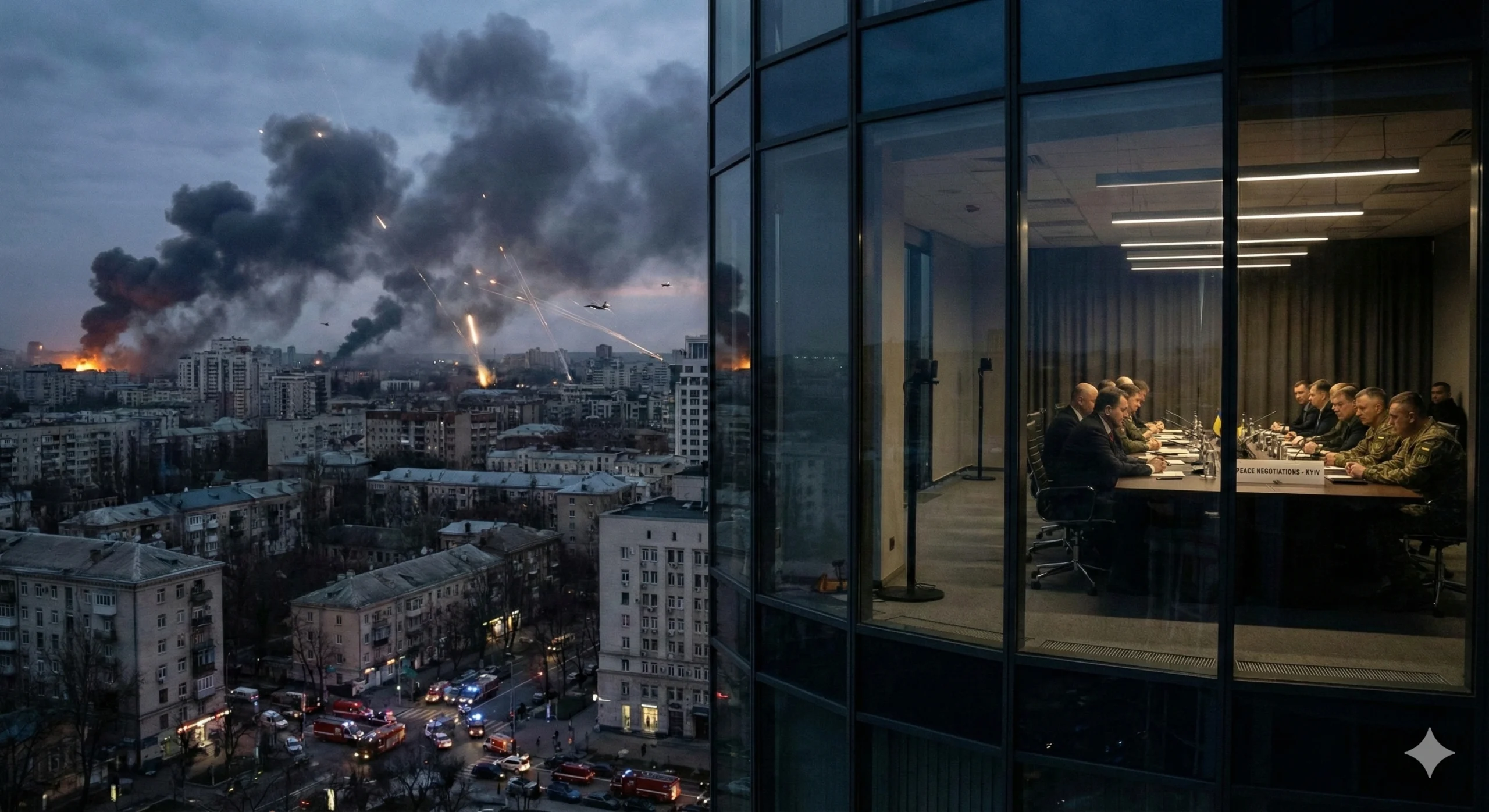
Russia’s Massive Drone-Missile Blitz Rocks Ukraine as Peace Talks Inch Forward—A Paradox of War
The contradictions of Ukraine’s war crystallized dramatically overnight into Saturday: while American diplomats and Ukrainian officials huddled in Florida hammering out frameworks for postwar security, Russian forces unleashed one of their most ferocious barrages in months—653 drones and 51 missiles screaming across Ukrainian airspace in a coordinated assault that left eight wounded and energy infrastructure smoldering. The juxtaposition underscores the brutal calculus of modern warfare: negotiations proceed in air-conditioned conference rooms while civilians shelter in basements, and Moscow sends a message through fire and steel that it negotiates only from positions of strength, not weakness.
Ukraine’s air force repelled much of the onslaught, neutralizing 585 drones and 30 missiles, yet 29 locations still sustained hits—predominantly energy facilities targeted with methodical precision. President Volodymyr Zelenskyy confirmed attackers zeroed in on power stations and infrastructure, including a drone strike that “burned down” the Fastiv train station in Kyiv region. The barrage triggered nationwide air raid alerts and demonstrated Russia’s continued capacity to inflict pain despite months of Ukrainian long-range strikes decimating Russian refineries and defense positions.
Most alarmingly, Ukraine’s Zaporizhzhia nuclear power plant—the largest in Europe, currently non-operational but containing six shutdown reactors and spent fuel requiring constant cooling—temporarily lost all external power. The International Atomic Energy Agency (IAEA) confirmed the loss, noting that reliable electricity prevents catastrophic nuclear incidents. Director General Rafael Mariano Grossi emphasized the precariousness: any prolonged blackout risks meltdown scenarios reminiscent of Fukushima, though backup diesel systems engaged. The plant, under Russian control since early 2022 invasion, sits hostage to Moscow’s targeting calculus.
The Diplomatic Parallel: Talks and Turmoil Intertwined
On Saturday morning, even as explosions rocked Ukraine, US Special Envoy Steve Witkoff and Trump’s son-in-law Jared Kushner were preparing for a third consecutive day of talks in Florida with Ukrainian negotiators Rustem Umerov and Andriy Hanatov. Friday’s session reportedly yielded “progress” on a post-war security framework – vague language that could signal agreement on modalities for NATO integration, security guarantees, or territorial safeguards. Yet both sides issued stark warnings: genuine peace depends entirely on “Russia demonstrating a serious commitment to lasting peace.”
This betrays a sense of frustration. Three days of talks have yielded no concrete results, only “broad strokes.” Trump administration officials are privately concerned that Russia is using diplomacy as cover for military repositioning, not genuine de-escalation. Moscow continues to demand concessions on Ukrainian territory – control of Donbas, recognition of Crimea – which Kyiv refuses to accept. Meanwhile, Ukraine’s Western supporters are experiencing fatigue: the endless war is draining NATO coffers; domestic US politics, under Trump’s “America First” policy, favors disengagement from foreign commitments.
The timing – the talks coinciding with Russia’s heaviest attacks in weeks – suggests a deliberate message. Moscow is signaling: we are not weakened, we control the escalation, your diplomacy will change nothing. Conversely, Kyiv is responding by attacking Russian refineries (the Ryazan oil facility was reportedly struck overnight, according to the Ukrainian General Staff and the Telegram channel Astra), demonstrating a continued capacity to strike despite losses to air defenses.
Energy War: Weaponizing Winter Against Civilians
According to Ukrainian officials, Russia’s overnight targeting of power infrastructure is part of a years-long campaign to weaponize the cold. As temperatures plummet toward the harsh Eastern European winter, electricity means heat, light, drinking water—the essentials of life. Moscow is systematically destroying Ukraine’s power grid; Kyiv is trying to rebuild it. Ukrainians huddled in dark apartments during the winter of 2022-2023; 2023-2024 was somewhat better; now, if Russia succeeds, 2025-2026 could be even worse.
Ukraine’s national energy operator, Ukrenergo, reported “massive missile and drone attacks” on power stations in several regions on Saturday, causing blackouts in countless cities. Hospitals had to run on generators; water treatment plants struggled; ordinary people are bracing for a fourth consecutive winter of blackouts. These are war crimes—targeting civilian infrastructure is a direct violation of the Geneva Conventions—yet Russia faces no accountability, exploiting the vacuum in international law.
Ukraine’s counter-strategy: attacking Russian refineries to deprive Moscow of the revenue from oil exports that funds its war machine. Months of long-range drone operations have crippled refinery capacity, forcing Putin to buy expensive black-market fuel. Yet Russia is absorbing these attacks and retaliating tenfold. Neither side is achieving a decisive victory in this kind of warfare.
Military Dynamics: Attrition Without End
Saturday’s figures reveal a harsh reality: Russia launched 704 aerial weapons (653 drones + 51 missiles); Ukraine intercepted 615 (85 drones + 30 missiles); yet 89 still managed to strike—a penetration rate of nearly 12% despite robust air defenses. Scale matters: Russia’s drone/missile production outpaces Ukraine’s interception capacity. U.S./NATO air defense systems help, but limited supply hinders long-term sustainability.
The Russian Ministry of Defense claims 116 Ukrainian drones were shot down over Russian territory overnight—these are unverified claims typical of wartime propaganda. Nevertheless, even if true, it demonstrates that Ukraine still possesses offensive capabilities. Drone warfare along the thousand-kilometer front line has become a grinding war of attrition, with neither side able to deliver a knockout blow.
Trump Administration Diplomacy: Pressure vs. Realism
Trump’s envoys emphasize security frameworks, hinting at creative solutions: NATO membership guarantees, demilitarization commitments, international monitoring regimes. Yet Russia demands territorial gains—Donbas, Crimea, land corridors—incompatible with Ukrainian sovereignty. Zelenskyy won’t concede legitimized annexations. Stalemate persists.
Privately, Trump officials consider “frozen conflict” resolution—ceasefire lines become semi-permanent borders, international buffer forces stabilize. Ukraine opposes—it means legitimizing conquest—but exhaustion may force pragmatism. Russia prefers battlefield gains before negotiating; overnight attacks serve that agenda, pressuring Ukraine toward accepting disadvantageous terms.
Nuclear Dimension: Zaporizhzhia’s Fragility
The Zaporizhzhia incident underscores nuclear risks. Russia controls the plant but needs electricity from Ukrainian grid. Power cuts threaten catastrophe. IAEA monitors remotely, issuing periodic warnings ignored by both sides. One miscalculation—a major strike severing backup systems—could contaminate swaths of Europe. Neither Moscow nor Kyiv wants nuclear disaster, yet both operate in reckless threshold territory.
Peaceful resolution requires denuclearization arrangements: international control, security protocols, guaranteed power supplies. Diplomacy must address this or risks Chornobyl 2.0.
Talks Without Breakthrough, War Without Victory
Saturday crystallizes the paradox: diplomacy proceeds, warfare rages, neither reaches conclusion. Trump pushes for settlement; Ukraine resists surrendering land; Russia demands conquered territory; Western fatigue deepens.
Most likely scenario: 2026 yields grinding attrition, occasional talks, no peace agreement. Winter suffering intensifies civilian pressure on Kyiv; economic costs mount globally. NATO allies tire; U.S. shifts focus. Putin calculates patience favors him—eventually Western will breaks.
Yet Ukraine’s resilience surprises: drone strikes persist, morale holds, civilians endure. Outcome remains uncertain—stalemate, frozen conflict, or eventual compromise all possible.
Saturday’s juxtaposition—diplomatic hope amid destructive reality—defines this stage: progress measured in vocabulary, not outcomes; negotiations without resolution; survival measured in kilowatt-hours.
Click Here to subscribe to our newsletters and get the latest updates directly to your inbox