
Trump Declares Fentanyl a ‘Weapon of Mass Destruction’: The War on Drugs Just Went Nuclear
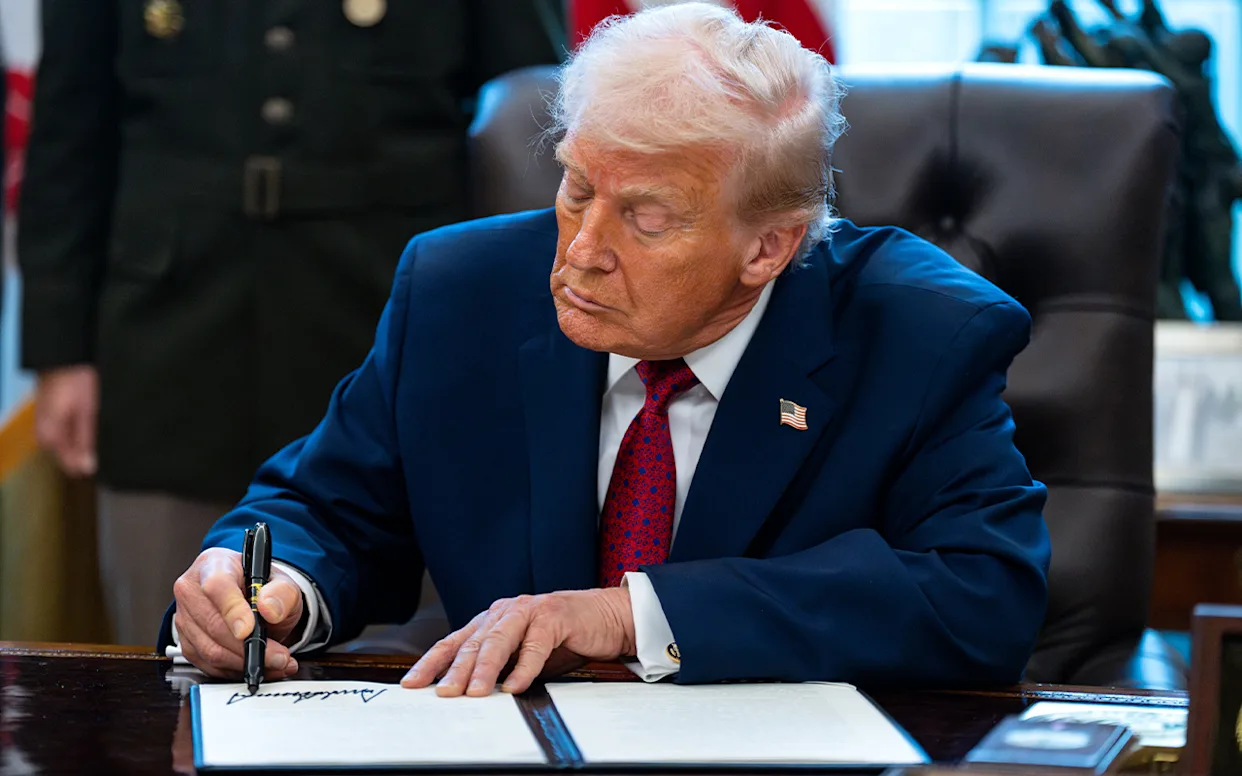
In a move that fundamentally reshapes American foreign policy and domestic security, President Donald Trump has crossed a geopolitical Rubicon. On Monday, standing before servicemembers deployed at the southern border, the President signed an executive order formally designating illicit fentanyl as a “Weapon of Mass Destruction” (WMD).
This is no longer just a metaphor. By classifying the synthetic opioid alongside chemical, biological, and nuclear threats, the administration has signaled that the era of treating the drug crisis as a law enforcement or public health issue is effectively over. The United States is now treating the fentanyl trade as an act of unconventional warfare, and it is authorizing a wartime response.
“We’re formally classifying fentanyl as a weapon of mass destruction, which is what it is,” Trump told the troops and the press. “They’re trying to drug out our country.”
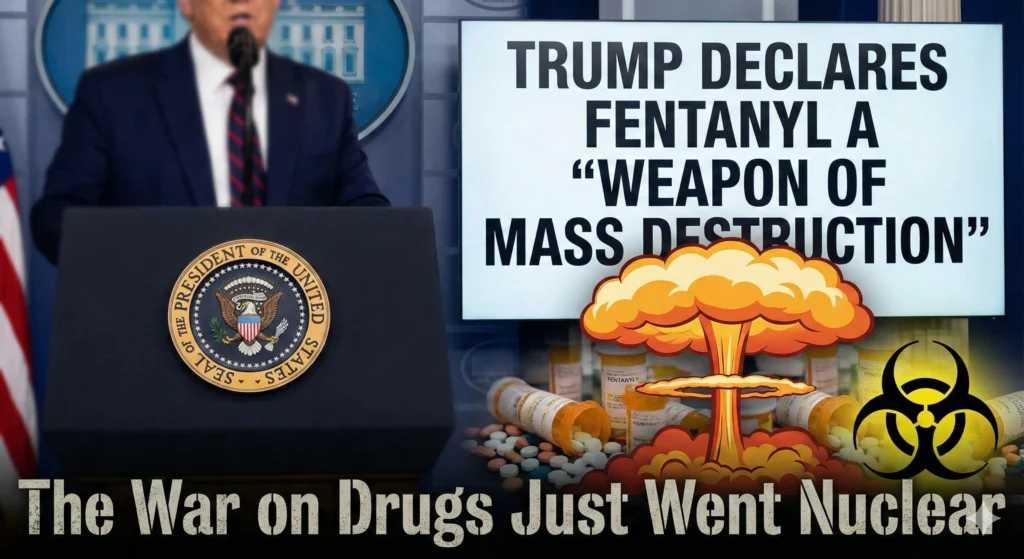
The executive order explicitly states that “illicit fentanyl is closer to a chemical weapon than a narcotic,” a semantic shift that unlocks a Pandora’s box of military and intelligence capabilities previously reserved for hunting down terrorists or rogue state actors.
From Law Enforcement to National Defense
To understand the gravity of this executive order, one must look at the distinction between fighting crime and fighting a war. Historically, the Drug Enforcement Administration (DEA) and the FBI have led the charge against narcotics. They build cases, seek extradition, and arrest traffickers.
The WMD designation flips this script entirely.
Under this new order, the Department of Defense (The Pentagon) is authorized to support law enforcement in ways that blur the lines of Posse Comitatus. More critically, it empowers the Intelligence Community—the CIA, NSA, and others—to utilize their full suite of surveillance and disruption tools against drug traffickers. We are moving from a strategy of “arrest and prosecute” to “detect and destroy.”
This escalation didn’t happen in a vacuum. Earlier this year, the Trump administration designated major drug cartels as Foreign Terrorist Organizations (FTOs). That designation was the first domino; the WMD classification is the second, much heavier domino. It provides the legal cover for the US military to operate outside of traditional boundaries, treating cartel logistics chains not as criminal enterprises, but as threats to the continuity of the United States.
The Kinetic Turn: Missiles in the Caribbean
The most alarming aspect of this policy shift is that it is already in motion, and it is lethal.
Since early September, following the FTO designation, the administration has engaged in a quiet but violent naval campaign. Reuters reports that the US has carried out over 20 strikes on suspected drug vessels in the Caribbean and Pacific waters. These operations have resulted in the deaths of more than 80 people.
These are not boarding actions where the Coast Guard arrests the crew and seizes the contraband. These are kinetic strikes—missiles or heavy munitions used to sink vessels entirely.
Legal experts and human rights watchdogs are raising red flags. The core criticism is the lack of due process and the murky rules of engagement. In a traditional drug interdiction, evidence is gathered after the seizure. In these strikes, the evidence is sinking to the bottom of the ocean. Reports suggest there is scant public evidence provided to prove these vessels were indeed carrying fentanyl, or that lethal force was the only option available.
The administration argues that the “self-defense” of the nation justifies the strikes. If fentanyl is a WMD, and a boat is carrying it toward a US city, the logic follows that sinking the boat is akin to shooting down a missile. However, critics argue this effectively authorizes extrajudicial killings of smugglers—and potentially civilians or coerced crew members—on the high seas.
The Public Divide and Legal Quagmire
Despite the populist appeal of “getting tough” on cartels, the American public is not unified on this approach. A recent Reuters/Ipsos poll published on Wednesday highlights a surprising fracture in the President’s support base. The data shows that many Americans oppose direct military campaigns against these vessels. Notably, about 20% of Republicans—Trump’s core demographic—expressed opposition to the military escalation.
This hesitation likely stems from two anxieties. First, the fear of “forever wars” shifting from the Middle East to the American doorstep. Second, the moral ambiguity of sinking ships without trial.
Legally, the WMD designation is a high-wire act. WMDs are traditionally defined by their intent—weapons designed to kill large numbers of people indiscriminately. Fentanyl, while deadly, is a commercial product sold for profit; death is a toxic side effect, not the primary goal of the cartel. By redefining a narcotic as a chemical weapon, the Trump administration is rewriting the definitions of international conflict.
The Western Hemisphere Strategy: Eyes on Mexico and China
The executive order also has profound diplomatic implications, specifically for US-Mexico and US-China relations.
The administration’s strategy document emphasizes a renewed focus on maintaining “influence in the Western Hemisphere.” Trump has not minced words regarding his willingness to order military strikes on land in Venezuela, Colombia, and, most controversially, Mexico.
Mexican sovereignty is now directly at odds with US national security policy. Most illicit fentanyl entering the US flows across the southern border, manufactured in Mexican labs using precursor chemicals sourced largely from China.
By calling fentanyl a WMD, Trump is essentially accusing Mexico of harboring weapons of mass destruction that target American citizens. This rhetoric lays the groundwork for potential unilateral military action on Mexican soil—drone strikes on labs or special forces raids—without the permission of the Mexican government. Such a move would spark a diplomatic crisis of unprecedented scale with America’s largest trading partner.
Furthermore, this puts China in the crosshairs. If the precursors are the “components” of a WMD, the US may soon ramp up sanctions or aggressive interdiction efforts against Chinese shipping, further straining an already fragile relationship between the superpowers.
The Human Cost vs. The Military Solution
There is no debating the severity of the fentanyl crisis. It is a leading cause of overdose deaths in the United States, claiming tens of thousands of lives annually. It destroys families, hollows out communities, and strains the healthcare system. The anger driving this policy is real and palpable.
However, history offers a grim warning regarding the militarization of drug policy. The “War on Drugs” has been waged for decades with limited success in curbing supply. Escalating to actual warfare—missiles, drones, and WMD designations—raises the stakes exponentially.
The risk of collateral damage is high. Intelligence is rarely perfect. If a US strike hits a fishing boat mistakenly identified as a “narco-sub,” or destroys a village in Colombia suspected of housing a lab, the geopolitical fallout will be swift. Moreover, violence tends to beget violence. Cartels, already heavily armed, may respond to US military engagement with increased terrorism tactics, further destabilizing the region.
A New Era of Unilateralism
President Trump’s signing of this executive order is a definitive statement: The United States is finished asking for cooperation. It is moving to a posture of unilateral enforcement.
By labeling fentanyl a Weapon of Mass Destruction, the administration has removed the handcuffs from the Pentagon and the CIA. The operational tempo is likely to increase, the strikes will likely continue, and the legal justifications will be stretched to their absolute limits.
Whether this aggressive posture will actually stop the flow of drugs remains the ultimate question. But one thing is certain: the waters of the Caribbean and the deserts of the borderlands have just become active war zones. The rules of engagement have changed, and the world is holding its breath to see where the next missile lands.
Click Here to subscribe to our newsletters and get the latest updates directly to your inbox