

Rupee Falls Past 91 per Dollar: Trade Deal Delays, FPI Outflows and RBI Strategy Explained
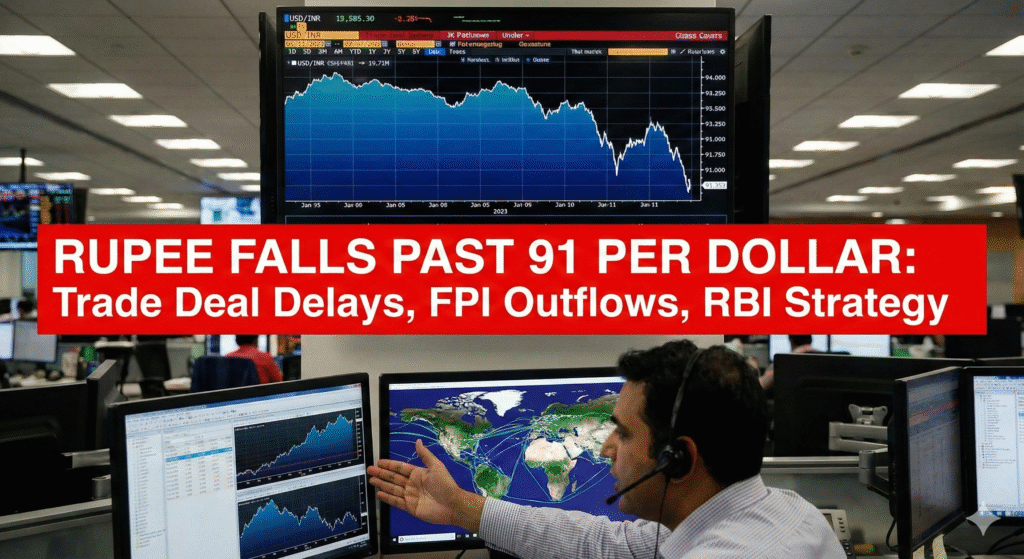
The Indian rupee slipped past the psychologically important 91-per-dollar mark on Tuesday, closing at an all-time low of 91.03 against the US dollar. The move marks a significant milestone for the currency, which took just nine trading sessions to depreciate from 90 to 91. During intraday trade, the rupee touched a low of 91.08, reflecting sustained pressure from both domestic and global factors.
The sharp decline comes amid delays in finalising the India–US trade agreement, continued outflows from foreign portfolio investors (FPIs), and a broader global risk-off environment. While the fall has raised concerns among investors and importers, market experts suggest the move is more a reflection of global uncertainty and policy tolerance than a sudden deterioration in India’s economic fundamentals.
Trade Deal Uncertainty Weighs on Market Sentiment
One of the key triggers behind the rupee’s slide has been uncertainty surrounding the India–US trade negotiations. Progress on the deal has reportedly slowed due to disagreements over sensitive sectors such as agriculture and dairy, where India has maintained firm red lines.
According to Dipti Chitale, CEO of Mecklai Financial Services Pvt Ltd, the rupee breached the 91 mark as delays and hurdles in trade talks dampened market sentiment. Currency markets are highly sensitive to policy clarity, and prolonged uncertainty often results in defensive positioning by traders. In this case, the absence of a clear timeline for the trade deal has added to near-term pressure on the rupee.
The concern for markets is not necessarily that the deal will collapse, but that extended delays reduce visibility on future trade flows, investment sentiment, and bilateral economic cooperation.
RBI’s Limited Intervention Sends a Signal
Another notable feature of the rupee’s fall has been the Reserve Bank of India’s relatively limited presence in the foreign exchange market. Dealers pointed out that the absence of aggressive RBI intervention allowed the currency to slip to a fresh all-time low.
Market participants interpret this restraint as a deliberate policy choice rather than a lack of capacity. With India’s economic growth remaining resilient and inflation largely under control, policymakers may be comfortable allowing some degree of currency depreciation.
Anindya Banerjee, head of currency and commodity research at Kotak Securities, noted that in a global environment marked by trade tensions and slowing growth, a slightly weaker currency can help support export competitiveness. As long as the depreciation remains orderly, the RBI may prefer to conserve its firepower and avoid defending specific levels.
RBI’s USD/INR Swap Auction and Liquidity Impact
On the same day, the RBI conducted a USD/INR buy–sell swap auction, adding another layer to market dynamics. The central bank received 222 bids worth $10.35 billion and accepted 118 bids amounting to $5.07 billion.
While such swap auctions are primarily aimed at managing long-term liquidity conditions, they can influence short-term currency sentiment. Traders often perceive these operations as increasing near-term dollar demand, which can add pressure on the rupee in the spot market, especially when combined with weak sentiment.
Persistent FPI Outflows Add to Dollar Demand
Foreign portfolio investor activity has been another major factor behind the rupee’s weakness. According to data from the National Securities Depository Ltd (NSDL), FPIs have sold equities worth ₹17,242 crore through exchanges so far in December. This takes the total equity outflow in 2025 to ₹1.61 lakh crore.
When foreign investors exit Indian equities, they typically convert rupee holdings back into dollars, increasing dollar demand and weakening the domestic currency. Sustained outflows therefore create a structural headwind for the rupee, regardless of domestic macroeconomic strength.
While some of these outflows are driven by India-specific factors such as valuations, a significant portion reflects global portfolio rebalancing amid rising yields in developed markets.
Global Pressures: US Yields and Yen Carry Trade Unwind
Global developments have also played a critical role in pushing the rupee lower. Rising US bond yields have made dollar assets more attractive, drawing capital away from emerging markets. At the same time, expectations of a potential interest rate hike by the Bank of Japan have triggered an unwinding of the yen carry trade.
The yen carry trade, where investors borrow cheaply in yen and invest in higher-yielding assets elsewhere, has been a major source of global liquidity. As this trade unwinds, risk appetite declines across asset classes, including equities, credit, cryptocurrencies, and commodities.
Emerging-market currencies like the rupee tend to suffer in such risk-averse environments, as investors seek safety in the dollar and other reserve currencies.
RBI Governor’s Perspective on Rupee Volatility
Earlier this month, RBI Governor Sanjay Malhotra sought to calm market nerves by downplaying concerns over the rupee’s fall. He stated that volatility in currency markets is not unusual and emphasised that the RBI is well placed to manage such movements.
The governor also highlighted the depth and efficiency of India’s foreign exchange market, suggesting that not every bout of volatility warrants intervention. This stance reinforces the view that the central bank is focused on preventing disorderly movements rather than defending specific exchange rate levels.
Key Technical Levels to Watch
From a technical perspective, the 90-per-dollar level, which previously acted as a strong psychological support, has now been decisively breached. In the near term, analysts see 91.25 as an important resistance level. A sustained move beyond this point could open the door to further depreciation.
However, if global sentiment stabilises or if the RBI signals discomfort with the pace of decline through verbal or actual intervention, the rupee could find some support. Much will depend on developments in global bond markets, capital flows, and progress on key policy fronts.
Is a Weaker Rupee a Sign of Economic Weakness?
Despite alarming headlines, a weaker rupee does not automatically imply that India’s economy is weakening. Currency movements are influenced by a complex mix of domestic fundamentals, global liquidity, capital flows, and policy choices.
India’s growth outlook remains relatively strong compared to many peers, and inflation has stayed within manageable limits. In such a context, a gradual and controlled depreciation can be absorbed by the economy and may even provide support to exports and manufacturing.
The bigger risk lies not in the level of the rupee, but in the speed and volatility of its movement. Sharp, disorderly declines can hurt confidence and disrupt trade and investment decisions, while slow adjustments are generally easier to manage.
What Lies Ahead for the Rupee?
Looking ahead, the rupee’s trajectory will depend on several key factors. Progress, or the lack of it, in India–US trade negotiations will remain closely watched. Global central bank actions, particularly those of the US Federal Reserve and the Bank of Japan, will also play a crucial role in shaping capital flows.
In the short term, volatility is likely to persist, with markets reacting sharply to global data releases and policy signals. For investors and businesses, the focus should remain on fundamentals rather than headline levels.
The rupee’s breach of 91 per dollar is an important marker, but it is best seen as part of a broader global adjustment rather than a standalone crisis. How policymakers and markets navigate this phase will determine whether the move remains a temporary spike or the beginning of a new trading range.
Click Here to subscribe to our newsletters and get the latest updates directly to your inbox