
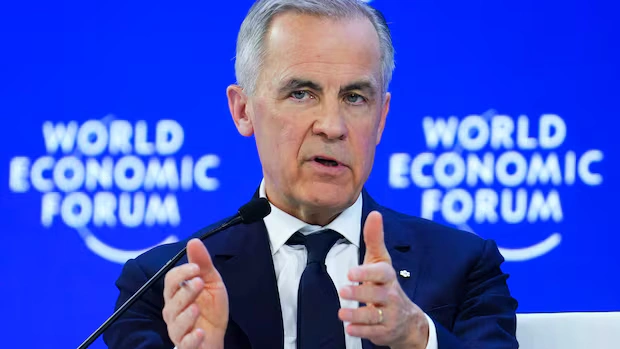
‘I Meant What I Said’: Canada PM Carney Stands by His Davos Speech, Denies Walking Back in Call With Trump
Canadian Prime Minister Mark Carney reaffirmed his controversial remarks made at the World Economic Forum in Davos, rejecting claims that he softened them during a private phone call with U.S. President Donald Trump. Carney’s comments, delivered earlier this month in Switzerland, criticised shifts in the global order and highlighted rising geopolitical tensions, drawing attention from world leaders, media, and diplomats. After a senior U.S. official suggested Carney walked back parts of his speech, the prime minister took to Parliament Hill to make a clear statement: he meant exactly what he said in Davos.
This episode underscores evolving dynamics in Canada–U.S. relations and reflects broader debates about global leadership, trade, and geopolitical strategy in an era of shifting alliances.
Revisiting the Davos Speech
Carney’s address at the World Economic Forum earlier in January gained international notice because it broke with diplomatic niceties and directly challenged the idea that the post-World War II “rules-based” international system remains intact. He described the world order as being in the midst of a “rupture,” shaped by economic coercion, tariff warfare, and strategic competition among major powers.
Analysts and leaders around the world praised Carney’s willingness to articulate concerns about geopolitical fragmentation. The speech was widely discussed as a call for “middle powers” — nations like Canada, the EU members, India, and others — to strengthen cooperation in defence, trade, and diplomacy rather than relying solely on traditional superpowers.
However, the remarks also provoked a sharp response from the Trump administration, which interpreted them as a direct critique of U.S. policies and leadership style.
U.S. Reaction and the Phone Call
A flashpoint in the story was a statement by Scott Bessent, a senior official in the U.S. Treasury, who told Fox News that Carney had been “very aggressively walking back some of the unfortunate remarks he made at Davos” during a phone conversation with President Trump. The suggestion was that Carney had tried to soften his criticism in private.
Carney was quick to deny that narrative. Speaking to reporters in Ottawa, he said the phone call with Trump covered a wide range of topics — including Ukraine, Venezuela, and Arctic security — but that he made no attempt to retract his earlier statements. “To be absolutely clear, and I said this to the president, I meant what I said in Davos,” the Canadian prime minister told the press.
He also noted that Canada was responding to changes in U.S. trade policy by expanding strategic partnerships and preparing to work within frameworks such as the US-Mexico-Canada Agreement (USMCA).
The Broader Context: Trade and Geopolitical Tensions
This diplomatic exchange did not occur in a vacuum. Relations between Ottawa and Washington have been under strain due to recent trade disputes and the Trump administration’s aggressive tactics, including threats of steep tariffs on Canadian goods in response to Canada’s negotiations with other partners.
Trump’s offensive rhetoric at Davos — including a controversial suggestion that Canada’s prosperity depends on the United States — fuelled the tension. Carney, for his part, framed his remarks as a defence of Canadian sovereignty and a recognition of shifting global power dynamics.
The prime minister also highlighted that Canada is seeking to diversify its trade relationships beyond the United States, pursuing new deals across multiple continents and working to reduce its reliance on a single partner.
What Carney’s Position Signals
Carney’s refusal to retract his Davos comments — even after direct pushback from a major ally — signals Canada’s desire to assert an independent voice in global affairs. His stance reflects a broader thesis: that traditional alliances and long-standing global institutions may no longer provide the stability and predictability that smaller and middle powers once relied on.
This approach aligns with emerging trends in international relations, where countries seek diversified partnerships, multilateral cooperation outside traditional blocs, and greater strategic autonomy. For Canada, this means actively engaging with Europe, Asia, and other regions to build economic and security ties beyond North America.
The Rules-Based Order Debate
Carney’s remarks about the “rupture” in the rules-based world order have resonated in academic and policy circles. Critics of the concept argue that the notion of a stable, predictable international system was always aspirational and that great powers frequently exploited or bypassed rules when it served their interests.
Supporters of the rules-based framework counter that its erosion heightens the risks of conflict, economic coercion, and unpredictability, particularly for smaller nations caught between competing powers.
Carney’s call for constructive cooperation among middle powers reflects a response to these challenges: forging new mechanisms of collaboration that preserve core values such as human rights, peaceful dispute resolution, and economic openness, even as the traditional architecture of international relations evolves.
Domestic and International Reaction
Back home, Carney’s firm stance appears to have bolstered his reputation as a principled leader willing to speak candidly about global geopolitics. Some polls suggest that his approval ratings have risen in the wake of the Davos speech, illustrating domestic support for his critique of unilateralism and coercive tactics by powerful states.
Internationally, the episode has sparked debate about Canada’s role on the world stage. Analysts see Carney emerging as a voice for middle powers seeking to chart an independent course amid shifting alliances and contested global leadership.
Click Here to subscribe to our newsletters and get the latest updates directly to your inbox.