

New Inflation Series Explained: Why Food’s Weight Is Dropping Sharply in India’s CPI
India’s inflation measurement is undergoing a structural shift that could quietly but significantly change how price pressures are interpreted by policymakers, markets, and households. Under the new Consumer Price Index (CPI) series with 2024 as the base year, the weight of food and beverages is set to fall sharply from 45.86% to 36.75% according to documents released by the Ministry of Statistics and Programme Implementation.
At the same time, housing is emerging as a more influential component of the inflation basket. Along with new methods to track rent increases more accurately, this change is likely to alter the behaviour of headline inflation in the years ahead.
To understand why this matters, it is important to look at how India’s CPI works, why food has dominated it for decades, and what the rebalancing could mean for interest rates, fiscal policy, and everyday life.
Why Food Has Always Dominated India’s CPI
India’s CPI is designed to reflect the consumption patterns of an average household. For decades, food has commanded an unusually large share of the index compared to advanced economies. This is because a significant portion of household spending—especially in rural and lower-income urban households—goes toward food and beverages.
As a result, even small changes in food prices have had an outsized impact on headline inflation. A spike in vegetable prices or a fall in cereal costs often ended up shaping monetary policy debates, regardless of what was happening to housing, healthcare, or education costs.
Economists and central bankers have long argued that this structure makes India’s inflation more volatile and less reflective of underlying demand conditions.
What Changes in the New CPI Series
The new CPI series rebalances the consumption basket to better reflect how Indians spend their money today. With rising incomes, urbanisation, and changing lifestyles, households now spend a smaller share of their income on food and more on housing, transport, healthcare, and services.
Under the revised structure, food and beverages will account for 36.75% of the CPI, down from nearly 46%. Housing, meanwhile, gains a larger role, both through higher weights and improved measurement of rent inflation.
This shift brings India’s inflation framework closer to global norms, where food typically has a much lower weight in consumer price indices.
A Snapshot of the Old vs New CPI Structure
| CPI Component | Old Weight (Base 2012) | New Weight (Base 2024) |
|---|---|---|
| Food & Beverages | 45.86% | 36.75% |
| Housing | Lower | Higher |
| Core Items (excluding food & fuel) | Smaller role | More prominent |
This rebalancing does not mean food prices no longer matter. Instead, it reduces their ability to single-handedly swing the headline inflation number.
Why Policymakers Wanted This Change
The high food weight in CPI has been a long-standing concern for policymakers, including the Reserve Bank of India. Food prices in India are often driven by supply shocks—weather events, crop cycles, or global commodity movements—rather than domestic demand.
This created a challenge for monetary policy. Interest rate tools are not well-suited to controlling vegetable or cereal prices, yet the RBI was often forced to respond to food-driven inflation spikes.
By reducing food’s weight and increasing the importance of housing and services, the new CPI is expected to give a clearer signal of underlying inflationary pressures linked to demand and incomes.
Housing Takes Centre Stage
One of the most significant changes in the new series is the higher prominence of housing. This is not just a statistical tweak. It reflects the reality that housing costs—especially rents—have become a major expense for urban households.
Alongside higher weights, MoSPI has also adopted methodological changes to measure rent increases more accurately. This could result in housing inflation appearing higher and more persistent than before.
Unlike food prices, housing inflation tends to be sticky. Rents rarely fall quickly, even when economic growth slows. This means headline CPI may become less volatile but structurally higher during certain phases.
How This Would Have Changed Recent Inflation Prints
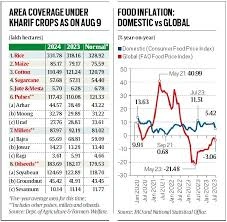
The impact of the new CPI structure becomes clear when looking at recent data. In the second half of 2025, food inflation turned sharply negative. From June 2025 onward, food prices were lower compared to the same months in 2024.
This dragged headline CPI down dramatically. In October 2025, headline inflation fell to an all-time low of 0.25%, while food inflation hit a record low of minus 5.02%.
Under the new CPI series, the same food price collapse would have had a smaller impact on the headline number, because food carries less weight. Inflation would likely have appeared higher and more stable.
Implications for Interest Rates
For the RBI, the new CPI series could change how inflation signals are read. With less noise from food prices, policymakers may place greater emphasis on core inflation components like housing, healthcare, and services.
This could lead to more measured interest rate decisions, less reactive to short-term food shocks. At the same time, persistently high housing inflation could limit how aggressively rates can be cut during downturns.
In effect, the new CPI may make monetary policy more predictable—but also less forgiving when structural inflation pressures build up.
What This Means for Households
For households, the changes may not be immediately visible, but they matter indirectly. Inflation figures influence interest rates, loan costs, and government policy decisions.
If headline inflation becomes less volatile, interest rates may also move in a smoother cycle. However, the increased weight of housing means rent increases could play a bigger role in shaping inflation perceptions.
Urban renters, in particular, may feel more accurately represented in the inflation data than before.
Impact on Markets and Government Policy
Financial markets track CPI closely because it shapes bond yields, currency expectations, and equity valuations. A CPI series that better reflects underlying inflation trends could reduce surprise shocks in markets.
For the government, the new series may influence fiscal planning, wage negotiations, and social welfare adjustments that are linked to inflation indices.
It may also affect how subsidies and price controls are evaluated, especially in food and housing sectors.
A Structural Shift, Not Just a Technical One
The move to lower food weight is not about downplaying the importance of food prices. It is about recognising that India’s economy has changed. Consumption patterns today look very different from a decade ago, and inflation measurement needs to keep pace.
By aligning CPI more closely with modern spending habits, the new series aims to provide a clearer picture of price pressures that matter for long-term stability.
Why This Matters Going Forward
Once implemented, the new CPI series will quietly reshape economic debates. Sudden swings in vegetable prices may no longer dominate inflation headlines, while steady rises in rent or services costs may gain more attention.
For policymakers, investors, and households alike, understanding this shift will be crucial to interpreting inflation data correctly in the years ahead.
Click Here to subscribe to our newsletters and get the latest updates directly to your inbox.