
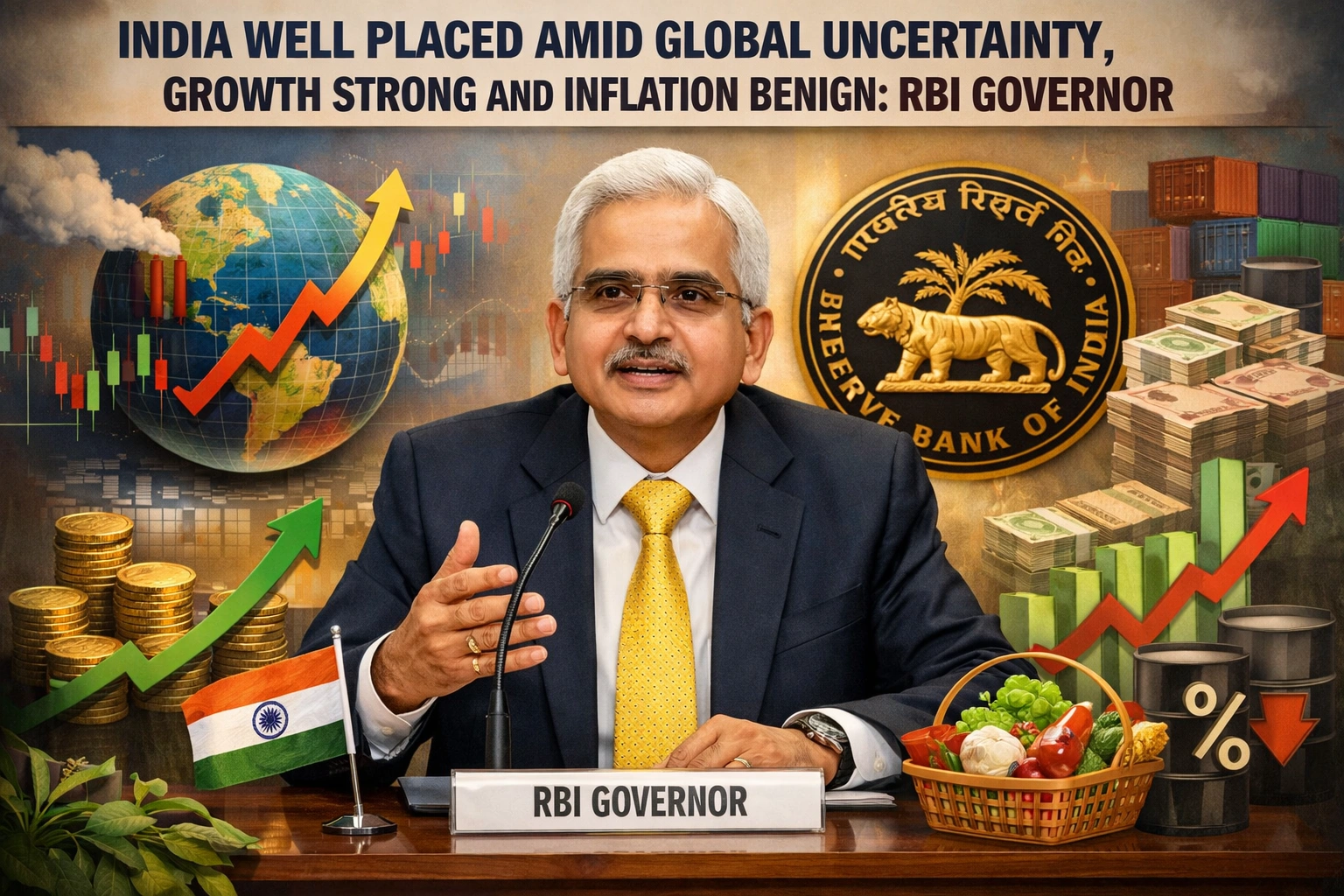
India Well Placed Amid Global Uncertainty, Growth Strong and Inflation Benign: RBI Governor
At a time when global markets are being rattled by geopolitical tensions, trade disruptions, and slowing growth across major economies, the Indian economy continues to stand out for its stability, according to Reserve Bank of India Governor Sanjay Malhotra. Speaking after the first monetary policy review of calendar year 2026, the Governor said India remains in a “good spot” with strong growth momentum and inflation firmly under control.
The remarks come as central banks worldwide struggle with the dual challenge of managing inflation while avoiding economic slowdown. In contrast, India’s macroeconomic indicators suggest that the country has managed to strike a delicate balance, supported by domestic demand, a resilient services sector, and improving manufacturing activity.
RBI’s Assessment of India’s Economic Position
Presenting the monetary policy decision, Governor Malhotra said India has weathered global headwinds better than many peer economies. Despite heightened geopolitical risks and uncertain global trade conditions, the domestic economy continues to show resilience.
The Governor emphasised that India’s growth story is being driven largely by internal factors rather than external tailwinds. Strong household consumption, steady government capital expenditure, and a recovery in private investment have helped offset global weaknesses.
He added that inflation remains comfortably below the RBI’s tolerance threshold, giving policymakers room to focus on sustaining growth rather than aggressively tightening monetary conditions.
Repo Rate Held Steady as Growth Outlook Improves
In its policy decision, the Monetary Policy Committee (MPC) voted to keep the repo rate unchanged at 5.25 per cent. The decision reflects the RBI’s confidence that current monetary settings are appropriate to support growth while keeping inflation in check.
More importantly, the RBI raised its GDP growth forecast for FY2026 by 10 basis points to 7.4 per cent, signalling optimism about economic momentum in the coming year. This revision places India among the fastest-growing major economies globally.
The RBI’s stance suggests that while it remains vigilant about inflation risks, it does not see an immediate need for tighter monetary policy.
Inflation Outlook Remains Benign
One of the most reassuring aspects of the RBI Governor’s statement was the assessment of inflation. According to Malhotra, inflation continues to stay below the tolerance band, and its outlook remains benign.
Food inflation, which has historically been volatile and a major concern for policymakers, has softened in recent months. Improved supply management, better agricultural output, and easing global commodity prices have all contributed to moderating price pressures.
At the same time, core inflation remains stable, indicating that underlying demand pressures are not excessive. This gives the RBI confidence that inflation risks are manageable in the near term.
Global Uncertainty and India’s Relative Strength
Globally, the economic environment remains fragile. Ongoing conflicts, trade tensions, and policy uncertainty in major economies have disrupted supply chains and dampened investment sentiment.
Against this backdrop, India’s relative stability has drawn attention. The RBI Governor noted that while global uncertainty remains elevated, India’s diversified economy and strong domestic demand provide a buffer against external shocks.
Unlike export-dependent economies that are highly sensitive to global slowdowns, India’s growth is increasingly driven by internal consumption and services. This structural advantage has helped the country remain resilient even as global growth slows.
Role of Domestic Demand and Services Sector
A key pillar of India’s economic strength is robust domestic demand. Consumer spending has remained resilient, supported by rising incomes, urban demand recovery, and improving employment conditions.
The services sector continues to perform strongly, particularly in areas such as information technology, financial services, tourism, and professional services. These sectors have helped offset weakness in global trade and manufacturing exports.
Improving manufacturing performance has also been a positive development. Policy initiatives aimed at boosting domestic production and reducing import dependence are gradually bearing fruit, according to the RBI’s assessment.
What the Numbers Say
To put the RBI’s outlook into perspective, here is a snapshot of key macro indicators highlighted in the policy review:
| Indicator | Latest RBI Outlook |
|---|---|
| Repo Rate | 5.25 per cent (unchanged) |
| FY2026 GDP Growth Forecast | 7.4 per cent |
| Inflation Trend | Below tolerance band |
| Economic Momentum | Strong and resilient |
These indicators underline why the central bank believes India is well-positioned amid global uncertainty.
Implications for Markets and Borrowers
For financial markets, the RBI’s stance provides stability and predictability. Holding rates steady reduces uncertainty for investors, businesses, and borrowers.
Lower inflation expectations and steady rates can support equity markets by improving earnings visibility and consumer sentiment. For borrowers, stable interest rates mean that loan costs are unlikely to rise sharply in the near term, offering relief to households and businesses alike.
At the same time, the RBI’s cautious tone suggests that it will remain data-dependent and responsive to any sudden changes in inflation or global conditions.
Challenges That Still Remain
While the outlook is positive, the RBI Governor also acknowledged that challenges persist. Geopolitical risks, energy price volatility, and potential disruptions to global supply chains could still impact the economy.
Additionally, sustaining high growth over the long term will require continued reforms, infrastructure investment, and improvements in productivity. The RBI’s optimism does not imply complacency, but rather confidence based on current data and trends.
Why RBI’s Message Matters
The RBI Governor’s message serves as reassurance at a time when global economic narratives are dominated by uncertainty and risk. By highlighting India’s strong growth and benign inflation, the central bank is signalling confidence in the country’s macroeconomic fundamentals.
For policymakers, investors, and businesses, this assessment reinforces the view that India remains one of the more stable and attractive economies in an otherwise volatile global environment.
Click Here to subscribe to our newsletters and get the latest updates directly to your inbox.