
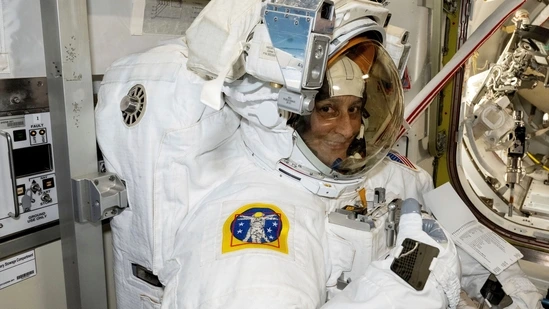
NASA Astronauts Sunita Williams and Butch Wilmore Return to Earth: 45-Day Rehabilitation After Extended SpaceX Rescue Mission
On September 22, 2024, NASA astronauts Butch Wilmore and Sunita Williams returned to Earth after a record nine-month delay in space, marking the end of an exceptionally long mission. They had a spectacular end to their journey along the Florida coast, homebound with the help of SpaceX’s Crew-9 Dragon spacecraft. The astronauts, who first boarded Boeing’s troubled Starliner spacecraft in June 2024, faced new realities of modern spaceflight and previously unheard-of difficulties that tested human resiliency. Now that they are back on solid ground, Williams and Wilmore will go through a rigorous 45-day rehabilitation program to address the physical strains of their extended stay in microgravity.
A Harrowing Journey: From Starliner Setbacks to SpaceX’s Rescue
What was supposed to be a historic mission—the first crewed flight of Boeing’s Starliner spacecraft—was the starting point of Williams and Wilmore’s ordeal. As part of NASA’s Commercial Crew Program, the pair launched Starliner on June 10, 2024, to confirm its capabilities. However, the spacecraft experienced critical propulsion system failures soon after docking at the ISS. The Starliner was deemed unfit for reentry after engineers discovered numerous helium leaks and malfunctioning thrusters. Prioritizing safety, NASA and Boeing decided to postpone the astronauts’ return indefinitely, leaving them stranded on the ISS while they looked for answers.
The incident demonstrated the dangers of depending on unproven spacecraft. NASA sought help from its reliable partner, SpaceX, while Boeing attempted to identify the Starliner’s problems. Williams and Wilmore were moved to SpaceX’s Crew-9 mission, which was initially planned to transport four astronauts to the ISS in September 2024, as part of a calculated mission reorganization. Crew-9’s crew was trimmed to two members to make room for the stranded couple, which gave Williams and Wilmore seats for their eventual return.
Homecoming: Crew-9’s Emotional Departure and Splashdown
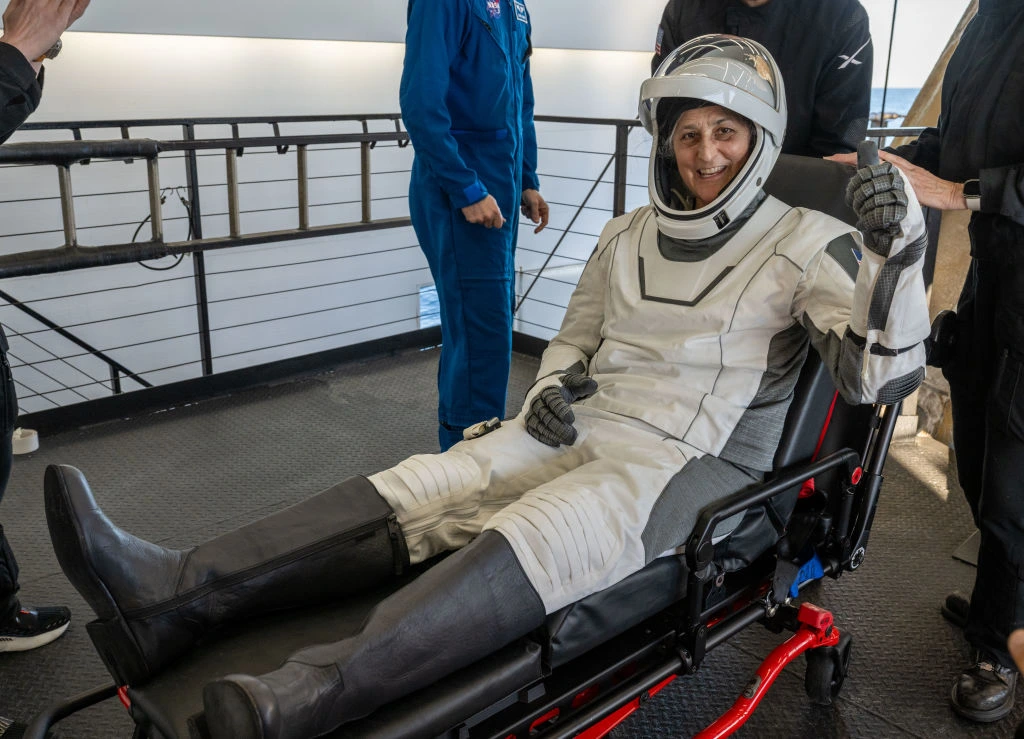
On September 21, Williams and Wilmore said goodbye to their ISS coworkers and stepped onto the Crew-9 Dragon spacecraft with Crew-10 astronauts who had come in to take their places. The astronauts and their families experienced an emotional turning point when the Dragon departed, ending a period of uncertainty. At 8:14 a.m. EDT, the spacecraft’s automated systems led it through a fiery reentry, which ended with a parachute-assisted splashdown in the Atlantic Ocean close to Florida’s coastline. Recovery crews quickly recovered the capsule and led the crew to medical examinations.
Millions of people watched the event live on SpaceX’s platforms and NASA’s YouTube channel, garnering international attention. As they reacclimated to gravity’s renewed pull, viewers saw the astronauts’ first moments back on Earth: a feeble smile that contrasted sharply with
The Road to Recovery: Understanding the 45-Day Rehabilitation
The human body suffers greatly from prolonged spaceflight. Muscles weaken, bones become less dense, and bodily fluids move upward in microgravity, which may impair vision. Balance becomes unstable as cardiovascular systems deteriorate. These effects are particularly noticeable for Williams and Wilmore, who stayed in orbit for almost nine months, which is a significant amount of time compared to their original eight-day mission.
NASA’s rehabilitation program, tailored to their unique needs, will unfold in three phases:
- Immediate Post-Landing Care: Focused on hydration, nutrition, and gradual preacclimation to Earth’s gravity.
- Physical Therapy: Intensive strength training to rebuild muscle mass, coupled with balance exercises to restore coordination.
- Long-Term Monitoring: Regular check-ups to track bone density recovery, vision health, and cardiovascular function.
NASA’s Chief Scientist for Human Spaceflight, Dr. Julie Robinson, says the 45-day schedule isn’t random. Decades of research have demonstrated that astronauts require a minimum of six weeks to return to baseline health following extended missions. Even so, it could take years to completely reverse certain changes, such as bone loss.
Behind the Scenes: Why Rehabilitation Matters
Post-mission recovery carries significant risks. Astronauts run a higher risk of fractures, falls, and long-term health problems if nothing is done. For instance, research shows that, similar to osteoporosis, space travelers lose 1% to 2% of their bone density each month. Likewise, in microgravity, muscle mass can decrease by as much as 20%.
Williams and Wilmore’s regimen will include:
- Resistance Training: Using weighted suits and resistance bands to simulate Earth’s gravity.
- Hydrotherapy: Underwater treadmills to reduce joint stress while rebuilding endurance.
- Cognitive Exercises: Tasks to sharpen spatial awareness and counteract the “space fog” reported by some astronauts.
Psychological support is equally critical. Prolonged isolation and the stress of their ordeal necessitate counseling to address potential mental health challenges.
Lessons Learned: Implications for Future Missions
The experience of Williams and Wilmore demonstrates the potential benefits and risks of NASA’s public-private partnerships. Redundancy in crewed missions has come under scrutiny after Boeing’s Starliner setbacks, but SpaceX’s Crew Dragon proved invaluable. “This incident highlights the importance of having multiple commercial partners,” stated NASA Administrator Bill Nelson. “Another system can take over when the first one fails.”
The Starliner’s malfunctions are a financial setback for Boeing. NASA is demanding a thorough review before approving the spacecraft for further flights, so the company is under close scrutiny as it attempts to address the propulsion problems. Meanwhile, SpaceX’s reputation for dependability keeps reaffirming its position as NASA’s preferred launch supplier.
The Human Element: Sunita Williams’ Legacy
With two prior ISS expeditions under her belt, Sunita Williams has long been a trailblazer. Her perseverance exemplifies the spirit of the astronaut corps, as she holds records for the most spacewalks by a woman (seven) and cumulative time in space (more than 322 days before this mission). At a press conference prior to his return, Williams said, “Every mission teaches us something new.” “This one put us to the test, but it serves as a reminder that space travel is never a routine activity.”
Butch Wilmore, a veteran astronaut and former Navy captain, agreed with her. “We appreciate the teams that put in countless hours to get us home. This mission aimed to advance human knowledge, not just to survive.
Looking Ahead: What’s Next for the Astronauts?
Williams and Wilmore will move into advisory positions after their recovery, exchanging knowledge to support upcoming missions. Their information will help with long-duration spaceflight research, which is essential as NASA plans to send people to Mars in the 2030s.
The public views their safe return as evidence of human resourcefulness. As commercial spaceflight advances, so does our comprehension of human and mechanical resilience. The tale of Williams and Wilmore is not merely one of survival; it serves as a guide for conquering the unanticipated difficulties that exist outside of our atmosphere.
Click Here to subscribe to our newsletters and get the latest updates directly to your inbox