
Trump Moves to Dismantle Federal Education Oversight, Shifts Power to States with Sweeping Executive Order
Former President Donald Trump signed an executive order directing the dismantling of the U.S. Department of Education, a pillar of federal education policy since 1979, in a historic decision that is consistent with his long-standing promise to reduce the role of the federal government in American life. Trump praised the order as “restoring liberty” to families and schools, and it aims to decentralize education authority by giving states and local communities more control. The order was announced just one day after the White House confirmed its plans. Critics caution that the decision runs the risk of exacerbating disparities and tearing down decades of federal protections, even as the administration promises to maintain vital funding sources like Pell Grants for college students, Title I grants for low-income schools, and assistance for children with disabilities.
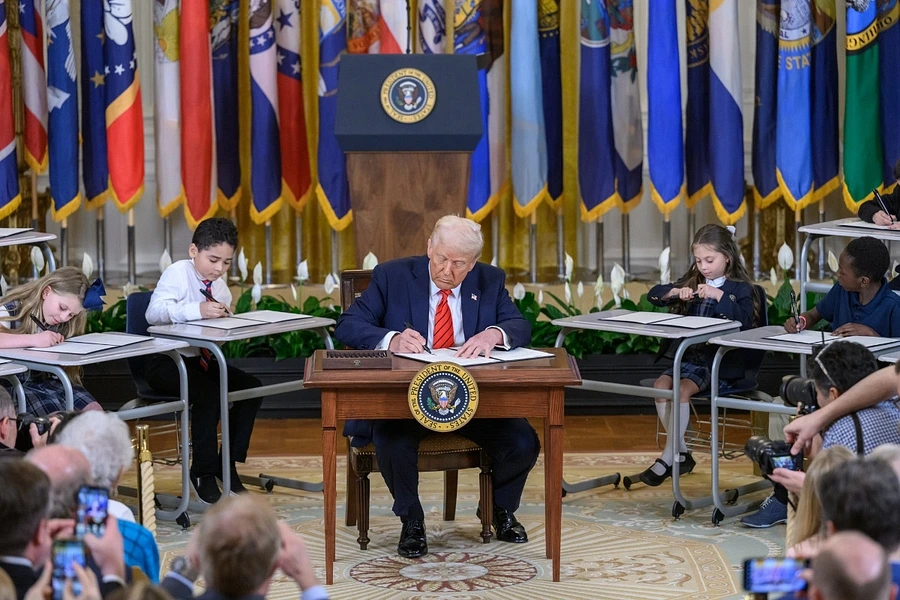
The Executive Order: Decentralizing American Education
The Secretary of Education is directed by Trump’s order to “take all necessary steps” to close the department and hand over its remaining duties to states or other federal agencies. According to the directive, only “core necessities” will continue to fall under federal jurisdiction, such as:
- Title I Funding: Critical support for schools serving high percentages of low-income students.
- Pell Grants: Financial aid enabling millions of low-income Americans to access higher education.
- Disabilities Support: Protections and resources for students under the Individuals with Disabilities Education Act (IDEA).
During the signing ceremony, Trump said, “Washington bureaucrats have dictated how our children are educated for too long.” “We’re ensuring that parents, educators, and communities—rather than remote regulators—shape what’s best for their students by giving states and local leaders back control.”
Historical Context: A Decades-Long Republican Goal
In an effort to make education a national priority, President Jimmy Carter established the Department of Education in 1979, consolidating federal education programs. Conservatives, however, have long criticized it, claiming it is an example of federal overreach. In the 1980s, President Ronald Reagan famously promised to abolish the department, but he encountered political obstacles. By portraying it as a remedy for “one-size-fits-all” policies that hinder local innovation, Trump’s order reignites this ideological conflict.
However, the action also reflects Trump’s larger plan to undermine federal agencies, which comes after he rolled back environmental rules, cut back on healthcare oversight, and tightened immigration enforcement. According to Dr. Linda Darling-Hammond, president of the California State Board of Education, “This isn’t just about education.” It’s a component of the ongoing decline in the federal government’s role in protecting vulnerable populations.”
Implications: A Double-Edged Sword for States
Its proponents argue that decentralization would enable states to tailor policy for their own purpose. Rural areas could emphasize career training, urban districts bilingual studies. “States know their students best,” asserted Oklahoma Superintendent Ryan Walters, arguably the plan’s biggest booster. “This order gets us out from under red tape that stifles creativity.”.
Others fear a patchwork of standards and assistance. Title I and IDEA already provide foundation-level protections to students who have been excluded, but without the force of federal enforcement, they could become larger. “What does it say about low-income districts in states that don’t fund schools adequately?” asked American Federation of Teachers president Randi Weingarten. “This is not empowerment—it’s abandonment.”
Higher education is also in the same uncertain state. Pell Grants would remain, but their administration might be splintered if handed over to the states with agendas that may conflict. “Pell is a lifeline for students,” said Dominique Baker, a professor of education policy at Southern Methodist University. “State control could mean unequal access, depending on where you live.
Political Reactions: A Partisan Divide
The measure has escalated America’s education culture wars. Republicans like House Speaker Mike Johnson hailed it as a triumph of parental rights and local control. “Democrats weaponized the Department of Education to advance radical ideologies,” Johnson asserted. “Now, communities can say no to woke agendas and concentrate on basics like reading and math.
Democrats and advocacy organizations decried the action as irresponsible. “This is a direct assault on educational equity,” said Senator Patty Murray (D-WA), chair of the Senate Education Committee. “Students with disabilities, children in poverty, and rural schools will be the losers.” Civil rights groups repeated the concerns, pointing out that federal monitoring has traditionally stepped in to desegregate schools and provide disability accommodations.
Legal and Logistical Hurdles
Even bold in intent, the order has significant obstacles to overcome. Disassembling a federal department requires congressional approval—a hurdle Trump’s aides circumvented by categorizing the order as reorganization, rather than dismantling. Lawyers are unconvinced. “The Department of Education is in existence because Congress made it,” UCLA law professor Jon Michaels explained. “An executive order can’t make that go away. This is political theater.
Even if it were partially adopted, the change would be uncoordinated. Over 4,000 employees and $80 billion in annual programs would need to be redeployed. States without an infrastructure to accommodate federal grants can expect delays, threatening teacher pay or student services.
The Road Ahead: A Blueprint for Future Administrations?
Although imminent dissolution is not a likelihood, Trump’s order provides a precedent for conservative rule. A future Republican president can build on the template to further starve or deemphasize federal education functions. Democratic administrations could be under pressure to recentralize power, redoubling policy whiplash with each presidential cycle.
For the time being, the order sends a message about Trump’s support for a states-rights agenda, rallying his base in preparation for a possible 2024 presidential bid. Its legacy, however, might rest on voter concerns: Do Americans have more confidence in state authorities than federal bureaucrats to educate their children?
A Pivotal Moment for American Education
Trump’s executive order is a turning point in the federalism and education equity debate. It advocates for local control but risks dismantling protections for the country’s most vulnerable students. As states struggle with new responsibilities—and possible funding gaps—the ripple effects could redefine classrooms for generations.
Ultimately, the dismantling of the Department of Education isn’t just an administrative change. It’s a philosophical reckoning: Is education a shared national project or a local experiment? The answer will determine America’s future—one student at a time.
Click Here to subscribe to our newsletters and get the latest updates directly to your inbox.