
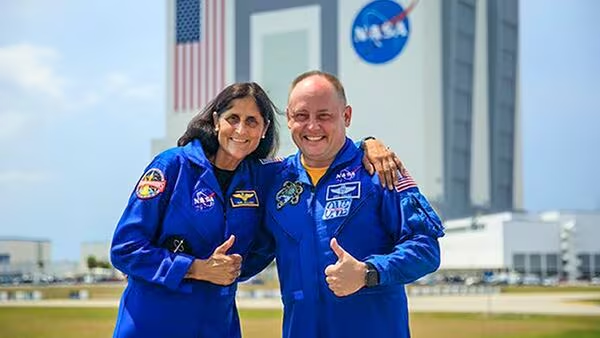
NASA Astronauts Sunita Williams and Wilmore Gear Up for Boeing Starliner Reflight: A Critical Step for NASA and Commercial Spaceflight
In a high-stakes gamble to salvage Boeing’s beleaguered Starliner program, NASA astronauts Sunita Williams and Barry “Butch” Wilmore are gearing up to ride the spacecraft again, months after their unexpected lengthy sojourn in space. The pair, who landed in June 2024 after a marathon 16-day mission marred by technical issues, have shown unshakeable faith in the Starliner’s preparedness for a second crewed flight. While Boeing scrambles to fix thruster malfunctions and helium leaks that have marred the Crew Flight Test (CFT), the reflight is not just a technical redo—it’s a turning point for NASA’s Commercial Crew Program, Boeing’s image, and American spaceflight’s future.

The Starliner’s Bumpy Journey
Boeing’s Starliner, a cornerstone of NASA’s effort to restore US crewed spaceflight since the retirement of the Space Shuttle, has ridden a rough road since inception. Intended to transport astronauts to the International Space Station (ISS) alongside SpaceX’s Crew Dragon, the spacecraft’s development has seen more delays, cost increases, and high-profile mishaps.
The May 2024 Crew Flight Test (CFT)—Starliner’s first crewed flight—was intended to certify the spacecraft for routine ISS rotations. Instead, the flight uncovered fundamental flaws. Immediately after launch, the Starliner suffered multiple helium leaks in its propulsion system and failures in five of its 28 reaction control thrusters. These issues, added to a defective valve in the service module, prompted NASA and Boeing to prolong the mission to 16 from 8 days as engineers hastened to debug.
Despite all these disappointments, Williams and Wilmore made it safely back to Earth, touching down in the New Mexico desert on June 22. Now, their willingness to get back on board the Starliner is a new beginning. “This spacecraft is like a thoroughbred—it just needs a little tuning,” Wilmore explained during a post-mission press conference
Astronauts’ Confidence: “We’d Fly It Tomorrow”
Both Wilmore and Williams, veteran test pilots with years of NASA experience between them, are Starliner’s most ardent champions. Two-time veteran of long-duration ISS missions Sunita Williams focused on the spacecraft’s toughness in a recent interview: “Every new vehicle has growing pains. We knew this was a test flight, and the data we gathered is invaluable.”
Wilmore, who is a former Navy commander and twice flew on the Space Shuttle, voiced the same sense of confidence. “If they tell us next week we’re flying, Butch and I are ready to go,” he said in an interview with Space News. Some of that is born of intimate contact with hardware fault-finding. Throughout the marathon mission, the duo hand-checked thrusters with ground-based crews and shadowed helium system behavior, real-time feedback which now informs Boeing’s repairs.
Technical Overhaul: How Boeing Is Fixing the Starliner
Boeing’s engineering team has spent months dissecting the CFT anomalies. Key fixes include:
- Thruster Redesign: Upgrading materials in the reaction control system (RCS) thrusters to prevent overheating and misfires.
- Helium Leak Mitigation: Reinforcing seals in the propulsion system and adding redundant helium valves.
- Software Updates: Enhancing thruster control algorithms to automatically compensate for malfunctions.
“We’ve torn this spacecraft apart,” said Mark Nappi, Boeing’s Starliner program manager. “Every component linked to the thruster and helium issues has been inspected, repaired, or replaced.” NASA has also imposed stricter oversight, with teams conducting “wall-to-wall” reviews of Boeing’s manufacturing processes.
Implications for NASA and Commercial Spaceflight
The stakes are too high. NASA’s Commercial Crew Program relies on two reliable suppliers—SpaceX and Boeing—to maintain uninterrupted access to the ISS. While SpaceX has flown 12 crewed flights since 2020, Boeing’s schedule slippages have caused NASA to rely too heavily on one vendor. Success for a Starliner reflight would return symmetry to this dynamic, bringing competition and redundancy.
“Diversity between providers is not up for discussion when it’s about crew safety,” said Kathy Lueders, the outgoing NASA head of space operations. “Boeing’s success is critical to our long-term ISS and Artemis strategy.”
For Boeing, the mission is do-or-die. The company has incurred nearly $1.5 billion in losses on Starliner overruns, and further failures risk jeopardizing its $4.2 billion NASA contract. With a success, though, Boeing would be well-positioned to bid for future contracts, including lunar missions under Artemis
The Astronauts’ Legacy: Test Pilots Turned Trailblazers
Williams and Wilmore add special experience to the mission. Williams, 59, also holds the record for most total spacewalk time by a female (50+ hours) and has logged 322 days in space over two ISS missions. Wilmore, 61, a veteran test pilot and a decorated war hero, commanded the STS-129 Shuttle mission and once lived on the ISS for 167 days.
Their test pilot background is perfect for Starliner’s high-risk reflight. “They’re not astronauts—they’re engineers in the cockpit,” declared NASA Administrator Bill Nelson. “Their input is helping shape the future of this spacecraft.”
Preparations for Relaunch: Training, Collaboration, and Countdown
With reflight now tentatively scheduled for early 2025, Williams and Wilmore are deep into simulations at the NASA Johnson Space Center. There are also new training modules for manual override procedures in the event of thruster failure, one of the lessons from CFT. Boeing also added virtual reality systems for practicing emergency scenarios.
Meanwhile, NASA and Boeing are conducting joint “tabletop” reviews to stress-test contingency plans. “We’re leaving nothing to chance,” said Steve Stich, NASA’s Commercial Crew Program manager. “This will be the most scrutinized spacecraft in history before it flies again.”
A Defining Moment for American Spaceflight
As Sunita Williams and Butch Wilmore prepare to board the Starliner again, their mission goes beyond Boeing’s redemption story. It’s a test of NASA’s public-private partnership model, a measure of Boeing’s engineering discipline, and a proving ground for the astronauts’ mantra: “Failure is not an option.”
Success would reassert America’s dominance in space exploration, setting the stage for Starliner to become a workhorse alongside Crew Dragon for ISS missions—and perhaps, deep-space missions. For Williams and Wilmore, whose careers have been marked by determination, this reflight is more than just another flight. It’s a legacy-defining leap of faith.
Click Here to subscribe to our newsletters and get the latest updates directly to your inbox.