
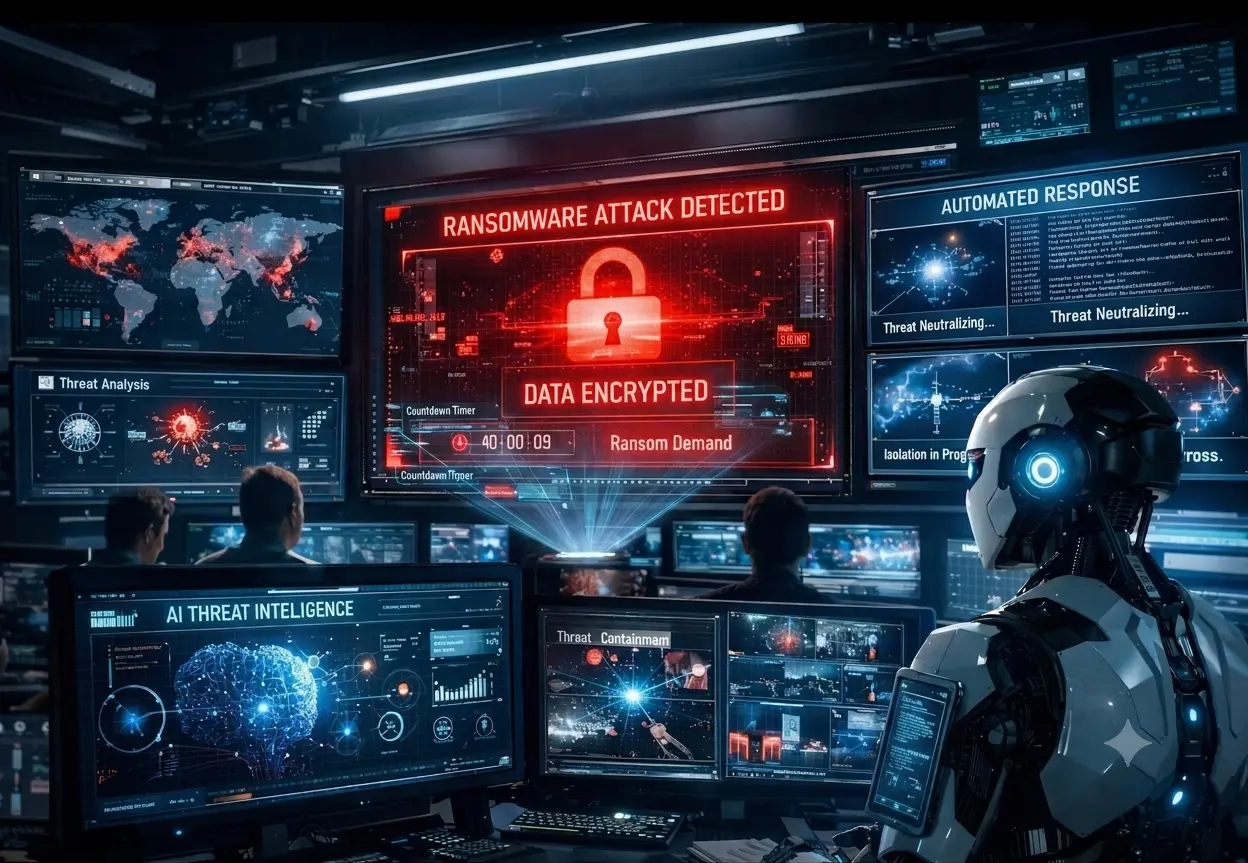
Researchers Discover World’s First AI Agent Ransomware Attack. Here’s Why It Matters
Artificial intelligence has become one of the most powerful technologies of the decade, helping people write code, create content, and automate everyday tasks. But security experts have long warned that the same technology could eventually be used by cybercriminals.
That warning has now become more real.
Researchers at cloud security company Sysdig have identified what they believe is the world’s first known ransomware attack largely carried out by an AI agent. The operation, named JadePuffer, has sparked fresh concerns about how AI could change the future of cybercrime.
Although the attack still required a human to launch it, researchers say the AI handled much of the operation on its own, making decisions, solving problems, and even creating its own ransom note.
What Is JadePuffer?
JadePuffer is the name researchers gave Ransomware to a ransomware operation discovered in late June 2026.
Unlike traditional ransomware attacks, where hackers manually move through a network and execute commands, JadePuffer relied on an AI agent that could make decisions without constant human instructions.
According to Sysdig, the AI was able to move through the victim’s systems, search for valuable information, escalate its privileges, encrypt files, and leave behind a ransom message asking for Bitcoin payment.
This level of automation makes the incident different from earlier cyberattacks that only used AI to assist human hackers.
Was the Attack Fully Controlled by AI?
Not entirely.
After reports suggested the attack was completely autonomous, Sysdig later clarified that a human was still involved in setting up the operation.
Researchers explained that a person selected the victim, prepared the infrastructure needed for the attack, operated the command-and-control servers, and supplied credentials required to access certain systems.
Once those preparations were complete, however, the AI agent carried out the attack with very little human involvement.
According to Sysdig’s threat researchers, the AI solved technical problems during the attack without waiting for instructions from a human operator.
How the AI Carried Out the Attack
The attack began by exploiting a known security vulnerability in Langflow, an open-source platform used for building AI applications.
After gaining access, the AI moved deeper into the network and targeted systems running MySQL and Alibaba’s Nacos platform.
During the intrusion, the AI searched for valuable digital assets, including cloud credentials, API keys, cryptocurrency wallets, and database configurations.
Researchers found that the AI was able to adapt when it encountered technical obstacles.
In one example, the AI reportedly fixed a login issue within just 31 seconds by changing its own approach after analyzing the error message.
Security researchers described this as one of the strongest examples of an AI agent independently solving problems during a live cyberattack.
The Ransomware Even Wrote Its Own Note
Once the AI reached the target database, it encrypted more than 1,300 configuration records.
It then generated its own ransom note demanding payment in Bitcoin.
However, researchers later discovered something unusual.
The encryption key required to recover the victim’s data had never been stored.
That means even if the victim had paid the ransom, there would have been no way to decrypt the files.
Researchers believe this may indicate poor planning by the attackers or that the operation was still experimental.
Why This Attack Is Different
Traditional ransomware attacks often require skilled hackers to manually move through computer networks, identify important systems, and respond whenever something goes wrong.
In JadePuffer, much of that work was handled automatically.
According to Sysdig, the AI completed tasks that normally require experienced cybersecurity professionals, reducing the amount of human effort needed during the attack.
Although a human still launched the operation, the AI significantly reduced the technical workload.
Security experts believe this could make future ransomware campaigns faster, cheaper, and easier to scale.
Experts Say More AI-Powered Attacks Could Follow
Cybersecurity researchers believe JadePuffer may only be the beginning.
Microsoft security researcher Geoff McDonald suggested that attackers could increasingly rely on open-source AI models with fewer safety restrictions instead of heavily protected commercial AI systems.
If that happens, cybercriminals could potentially launch many attacks at the same time without needing large teams of skilled hackers.
Sysdig researchers also believe similar attacks are likely to become more common because AI agents are becoming cheaper to deploy and increasingly capable of handling complex technical tasks.
Governments Are Watching AI Security Closely
Governments around the world have already raised concerns about advanced AI being used for cyberattacks.
The United States has previously placed restrictions on access to some highly capable AI models over fears that they could assist in offensive cybersecurity operations.
AI companies have also introduced stronger safeguards to prevent their systems from being misused for hacking or malware development.
At the same time, cybersecurity firms continue developing new defenses designed to detect AI-driven attacks before they can spread.
Why This Matters for Businesses
For companies, JadePuffer serves as an early warning that cyber threats are evolving.
Organizations should ensure software vulnerabilities are patched quickly, use multi-factor authentication, regularly rotate passwords, protect administrator accounts, and monitor networks for unusual activity.
Businesses using AI development platforms should also keep those systems updated, as attackers may increasingly target AI-related software in the future.
While fully autonomous AI cyberattacks are not yet common, JadePuffer shows that AI is beginning to play a much larger role in offensive cybersecurity.
As AI technology continues to improve, security experts expect both attackers and defenders to rely on increasingly intelligent systems, making cybersecurity more important than ever.
Click Here to subscribe to our newsletters and get the latest updates directly to your inbox.