
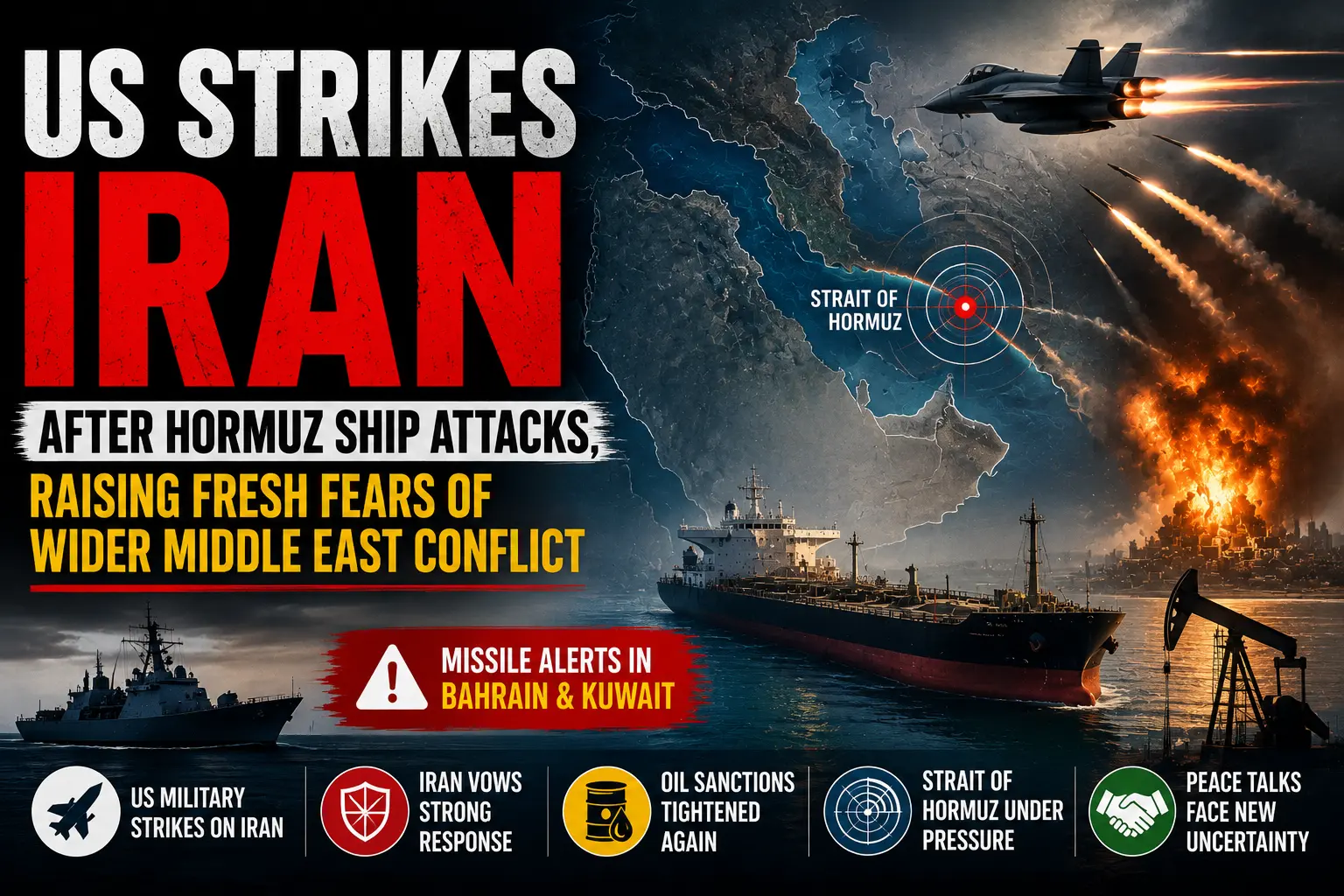
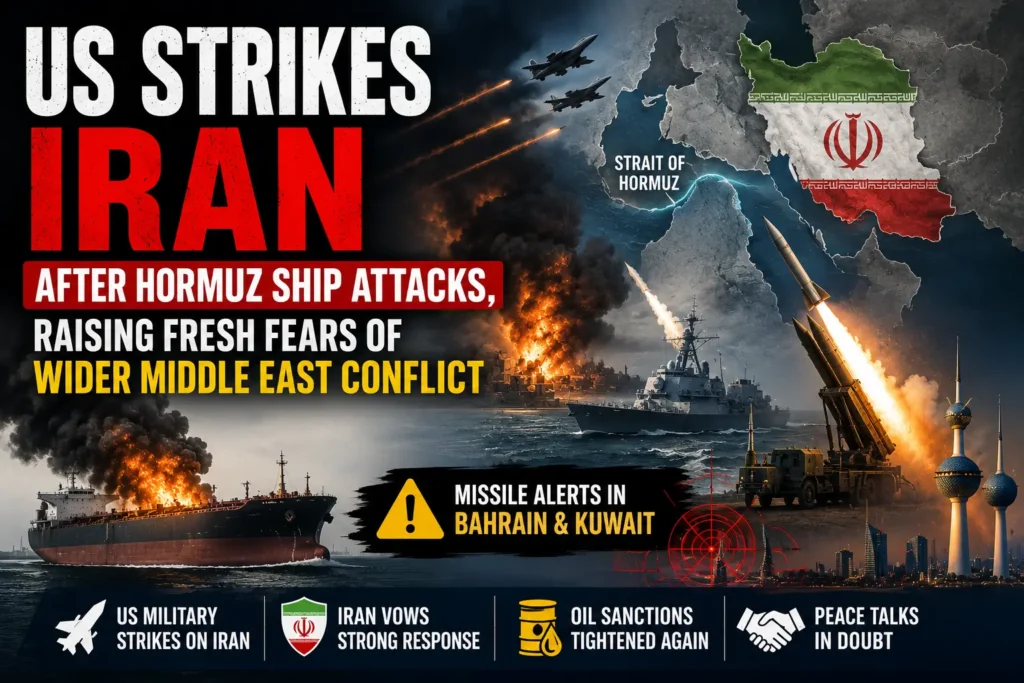
US Strikes Iran After Hormuz Ship Attacks, Raising Fresh Fears of Wider Middle East Conflict
US strikes Iran after Hormuz ship attacks, marking a major escalation in Middle East tensions. Washington said it targeted Iranian military infrastructure after accusing Tehran of attacking commercial vessels in the Strait of Hormuz. Reports of Iranian missile launches toward Bahrain and Kuwait have further raised concerns that the fragile ceasefire could collapse.
The latest exchange has also disrupted diplomatic efforts to reduce tensions, reopen the Strait of Hormuz, and revive negotiations over Iran’s nuclear programme. With both countries trading warnings, concerns are growing over regional security and global energy supplies.
Why Did the US Strike Iran After Hormuz Ship Attacks?
According to the US military, the strikes were carried out after three commercial vessels were attacked while passing through the Strait of Hormuz, one of the world’s busiest oil shipping routes.
US Central Command said the operation was intended to hold Iran responsible for actions that threatened civilian shipping in international waters. American forces targeted Iranian military infrastructure, including air defence systems, radar installations, and more than 60 fast attack boats operated by Iran’s Islamic Revolutionary Guard Corps (IRGC).
US officials described the action as a limited military response and stated that no additional strikes were planned at this stage.
Iran Responds With Strong Warning
Iran confirmed that explosions were reported in Bandar Abbas, Qeshm, and Sirik following the American operation but did not immediately release information about casualties or military losses.
Iran’s military condemned the strikes, calling them an act of aggression and warning that it would respond in a manner it considered appropriate.
Authorities also insisted that Iran would not allow any foreign country to interfere in matters related to the Strait of Hormuz, which remains one of the country’s most strategically important waterways.
Meanwhile, Iran’s Parliament Speaker Mohammad Bagher Ghalibaf said on social media that the country would not give in to pressure or intimidation.
Missile Alerts Issued in Bahrain and Kuwait
Shortly after the American operation, missile alerts were activated in Bahrain and Kuwait.
Both countries host major American military facilities, including the headquarters of the US Navy’s Fifth Fleet in Bahrain and several US Army installations in Kuwait.
Although officials have not released complete details about the reported missile launches, the incidents highlighted the growing risk that the conflict could spread beyond Iran and involve other countries in the Gulf region.
Military officials across the region have remained on high alert as tensions continue.
Oil Sanctions Tightened Again
Alongside the military operation, Washington also withdrew a licence that had temporarily allowed Iran to sell crude oil openly on international markets under an earlier interim agreement.
The decision effectively restores restrictions on Iran’s oil exports, making it more difficult for Tehran to sell crude through official international channels.
Iran has long faced sanctions on its energy sector, with previous reports suggesting that much of its oil exports continued through discounted sales to countries such as China.
Energy analysts say renewed restrictions could place additional pressure on global oil markets if tensions continue to disrupt shipping in the Gulf.
Why Is the Strait of Hormuz So Important?
The Strait of Hormuz handles nearly one-fifth of the world’s seaborne oil trade, making it one of the most important energy routes on the planet.
According to maritime monitoring agencies, one tanker operating near the coast of Oman caught fire after being struck during the latest incidents.
Iranian state media claimed the vessel ignored warnings before the attack but stopped short of officially accepting responsibility.
Any disruption in this narrow shipping corridor can quickly affect global oil prices, insurance costs, and international trade.
Peace Talks Face New Uncertainty
The latest military escalation comes at a sensitive time for diplomatic negotiations.
Officials had been preparing for another round of discussions focused on permanently reopening the Strait of Hormuz and addressing Iran’s nuclear programme after the funeral ceremonies for Iran’s Supreme Leader Ayatollah Ali Khamenei.
Those talks now appear uncertain as both sides exchange military actions instead of diplomatic messages.
Analysts believe rebuilding trust between Washington and Tehran will become significantly more difficult if further attacks occur.
Global Markets Watching Closely
Financial markets and energy companies are closely monitoring developments in the Gulf.
Any prolonged disruption to shipping through the Strait of Hormuz could affect oil supplies, fuel prices, and inflation in many countries that rely on Middle Eastern energy exports.
Shipping companies may also face higher insurance premiums and security costs if attacks continue in one of the world’s busiest maritime corridors.
What Happens Next?
Although US officials have described the latest strikes as a completed operation, the situation remains highly unpredictable.
Iran has promised a strong response, while Washington has warned it is prepared to act again if commercial shipping comes under further attack.
At the same time, international efforts to restart negotiations over Iran’s nuclear programme and regional security continue, but the latest exchange has made a diplomatic breakthrough far more challenging.
For now, the Middle East remains on edge as governments, energy markets, and shipping companies wait to see whether tensions ease or move toward another broader regional conflict.
Click Here to subscribe to our newsletters and get the latest updates directly to your inbox.
This article gave me valuable insight into this subject today and I look forward to reading more from you