

War Now Bigger Business Threat Than Civil Unrest, Says Allianz Risk Report 2026
Global businesses are now more concerned about war and geopolitical conflict than civil unrest when assessing political violence risks, according to the latest Allianz Risk Barometer 2026 report.
The report, titled Political Violence and Civil Unrest Trends 2026, highlights how ongoing conflicts in Europe and West Asia are reshaping corporate risk calculations worldwide. Companies are increasingly worried about supply chain disruptions, attacks on infrastructure, cyber threats, and instability spilling across international business ecosystems.
According to the Munich-based insurer, geopolitical conflict has now overtaken traditional civil unrest as the primary political violence concern for many firms operating globally.
That shift reflects how modern warfare is evolving far beyond battlefields and increasingly affecting trade routes, financial systems, technology networks, and commercial operations.
The ‘Gray Zone’ Between Peace and Open Warfare
One of the report’s most important warnings revolves around what Allianz calls the “gray zone” between peace and open warfare.
The company says modern threat actors are increasingly using the following:
- Cyber attacks
- Criminal networks
- Disinformation campaigns
- Infrastructure sabotage
- Proxy operations
to target governments, companies, and strategic systems without formally declaring war.
According to Allianz, this creates a dangerous environment where the lines between state actors, militant groups, and criminal organizations become increasingly blurred.
The report warns that critical infrastructure, high-profile companies, and even individuals are now being targeted through hybrid methods designed to avoid direct attribution while still causing economic and operational damage.
This reflects a broader global trend where technology has dramatically changed the nature of political violence and geopolitical conflict.
Europe and West Asia Driving Global Risk Concerns
The report specifically points to conflicts in Europe and West Asia as major contributors to rising business anxiety.
Wars and geopolitical tensions in these regions have already disrupted:
- Energy markets
- Shipping routes
- Supply chains
- Aviation operations
- Commodity pricing
Businesses are increasingly recognizing that regional conflicts can now trigger global economic consequences within days.
For example, instability around the Strait of Hormuz has significantly affected global fuel markets, while European geopolitical tensions continue impacting logistics, industrial production, and trade flows.
Allianz says these disruptions are forcing companies to rethink how resilient their global business ecosystems actually are.
Social Cohesion Deteriorating Worldwide
Although war has overtaken civil unrest as the top concern, Allianz also warned that social instability remains a serious global risk.
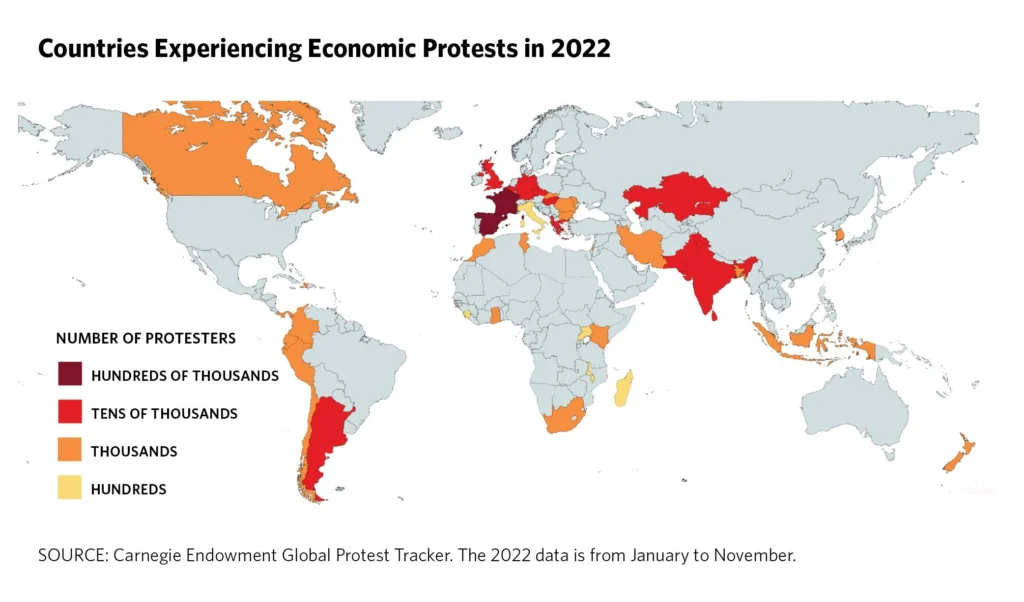
The report states that deteriorating social cohesion is contributing to rising protests and public unrest across multiple countries.
Interestingly, Allianz noted that civil unrest is no longer limited to politically fragile or economically weak nations.
Countries like France and Germany — both considered stable advanced economies — are now experiencing some of the most frequent protest movements globally.
Economic inequality, inflation, political polarization, and public dissatisfaction are increasingly driving demonstrations even in developed countries.
This suggests that businesses can no longer assume stability simply because they operate in mature economies.
Companies Rethinking Global Operations
The Allianz report suggests businesses are now fundamentally reevaluating how they manage international operations.
Companies are increasingly investing in:
- Supply chain diversification
- Cybersecurity infrastructure
- Risk intelligence systems
- Crisis planning
- Regional operational flexibility
Executives are also paying closer attention to geopolitical analysis than they did previously.
In earlier decades, political violence risk was often viewed as a regional issue affecting only certain markets. Today, multinational firms increasingly see geopolitical instability as a core operational threat capable of affecting global profitability and continuity.
Cyber Threats Becoming More Dangerous
Another major concern highlighted in the report is the growing sophistication of cyber-enabled political violence.
Allianz warned that cyberattacks linked to geopolitical conflict are becoming more aggressive and more difficult to detect.
Critical infrastructure such as the following:
- Power grids
- Banking systems
- Airports
- Telecommunications networks
- Logistics operations
are increasingly vulnerable to hybrid attacks carried out through both digital and physical methods.
The report suggests businesses should no longer treat cybersecurity as simply an IT issue. Instead, it must become part of broader geopolitical risk management strategies.
Public Reaction Reflects Growing Global Anxiety
Public reaction to the Allianz findings has been mixed but serious.
Many business analysts and economists agreed with the report’s conclusions, arguing that the world has entered a far more unstable geopolitical era compared to previous decades.
On social media and business forums, users discussed how conflicts in one region now rapidly affect:
- Fuel prices
- Inflation
- Stock markets
- Shipping costs
- Consumer confidence
Others pointed out that modern businesses are more interconnected than ever, making them more vulnerable to geopolitical shocks.
Some critics, however, argued that corporations themselves have contributed to instability through overdependence on fragile global supply chains and excessive cost-cutting strategies.
Economic Impact Extending Beyond Conflict Zones
One of the most important themes in the Allianz report is that modern geopolitical risks rarely stay confined geographically.
A conflict in one region can now affect:
- Airline operations worldwide
- Energy prices globally
- Manufacturing costs internationally
- Commodity availability across continents
The report warns that businesses must prepare for “cascading risk events,” where one geopolitical disruption triggers multiple secondary economic and operational problems.
This interconnectedness is making corporate risk management far more complicated than in previous decades.
Insurance Industry Seeing Rising Political Risk Exposure
For insurers like Allianz, rising geopolitical instability also represents a major industry challenge.
Political violence claims, cyberattack risks, and infrastructure damage are becoming increasingly expensive and unpredictable.
Insurers are now under pressure to reassess the following:
- Risk pricing models
- Global exposure calculations
- Infrastructure vulnerability
- Supply chain dependencies
The report reflects how deeply geopolitical instability is now influencing financial and insurance markets globally.
The Bigger Shift in Global Business Thinking
The Allianz report ultimately reveals something much larger:
Globalization itself is changing.
For decades, businesses optimized operations around efficiency, cost reduction, and international integration.
Now, companies are increasingly prioritizing the following:
- Resilience
- Redundancy
- Strategic flexibility
- Risk diversification
This marks a major philosophical shift in global corporate strategy.
Efficiency alone is no longer enough if geopolitical instability can suddenly disrupt entire supply chains or business regions.
Final Thoughts
The Allianz Risk Barometer 2026 paints a picture of a world where war, cyber threats, and geopolitical instability are becoming central business concerns rather than distant political issues.
Modern conflicts are no longer limited to battlefields. They now affect data networks, energy systems, supply chains, and everyday commercial operations worldwide.
For businesses, the challenge is becoming increasingly complex:
surviving in an economy where geopolitical uncertainty is no longer the exception—but potentially the new normal.
Click Here to subscribe to our newsletters and get the latest updates directly to your inbox.