
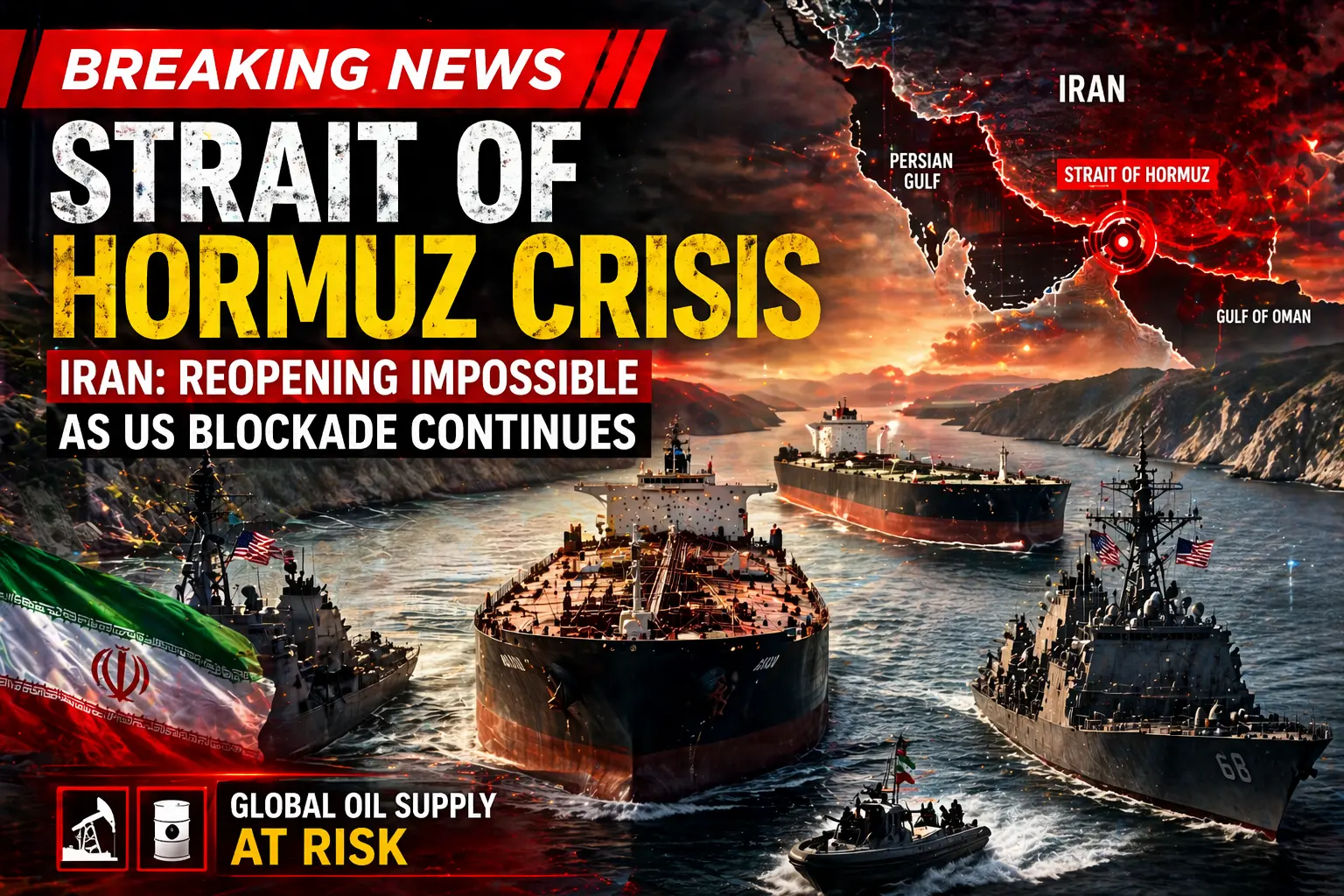
Iran Says Reopening Strait of Hormuz ‘Impossible’ Amid US Blockade Tensions
Iran says reopening the Strait of Hormuz is impossible due to the US naval blockade and ceasefire violations. Here’s what it means for global oil supply and security.
Iran Refuses to Reopen Strait of Hormuz
The Strait of Hormuz crisis has escalated sharply after Iran declared it is “not possible” to reopen the critical global shipping route as long as the United States maintains its naval blockade.
Iranian officials say the blockade represents a “blatant violation” of the recently extended ceasefire, raising fears of renewed tensions in one of the world’s most strategically important waterways.
The Strait of Hormuz handles nearly 20% of global oil shipments, making any disruption a major concern for the global economy.
Iran Blames US Blockade and Israel’s Actions
Iran’s top negotiator, Mohammad Bagher Ghalibaf, directly blamed the United States and Israel for escalating the crisis.
According to Iranian officials:
- The US naval blockade of Iranian ports violates the ceasefire
- Israeli military activity is increasing regional instability
- Ongoing “threats” are preventing diplomatic progress
Ghalibaf stated that under these conditions, reopening the Strait is not feasible, effectively signaling a hardline stance from Tehran.
US Maintains Naval Blockade
Despite extending the ceasefire, the United States has chosen to continue its naval blockade of Iranian ports.
Former U.S. President Donald Trump, who announced the ceasefire extension, also confirmed that the blockade would remain in place.
The White House has defended the move, stating that the blockade is necessary to maintain pressure on Iran and ensure compliance with international agreements.
Officials have indicated that Washington is “satisfied” with the current strategy, despite rising tensions.
Iran Seizes Cargo Ships in Strategic Waterway
In a major escalation, Iran recently seized two cargo ships in the Strait of Hormuz.
The incidents took place shortly after the ceasefire extension, raising concerns about maritime security in the region.
The seizures:
- Highlight Iran’s willingness to assert control over the waterway
- Increase risks for global shipping companies
- Signal potential retaliation against US actions
These developments have intensified fears that the Strait could become a flashpoint for further conflict.
Why the Strait of Hormuz Matters
The Strait of Hormuz crisis is critical because of the waterway’s global importance.
Located between the Persian Gulf and the Gulf of Oman, the Strait is one of the most vital energy corridors in the world.
Key facts:
- Around 20% of global oil passes through the Strait
- Major oil exporters rely on this route
- Any disruption can impact global fuel prices
If the Strait remains closed or unstable, it could lead to:
- Rising oil prices worldwide
- Increased shipping costs
- Economic pressure on energy-importing countries
Iran’s President Calls Blockade a Major Obstacle
Iran’s President Masoud Pezeshkian has also criticized the United States, calling the blockade and threats the “main obstacles” to negotiations.
He emphasized that:
- The blockade violates diplomatic commitments
- It undermines trust between the two countries
- It makes further talks difficult
Iran’s leadership has made it clear that lifting the blockade is essential for any progress in negotiations.
Delayed Talks Raise Concerns
Diplomatic talks between the United States and Iran were expected to resume this week in Pakistan, but they have yet to begin.
The delay has added to uncertainty surrounding the situation.
Key concerns include:
- Whether negotiations will resume at all
- The possibility of further escalation
- The role of mediators in resolving the crisis
Without dialogue, the risk of conflict in the region could increase significantly.
Global Impact of the Strait of Hormuz Crisis
The Strait of Hormuz crisis is not just a regional issue—it has global consequences.
1. Energy Markets
Any disruption could lead to a sharp rise in oil prices, affecting economies worldwide.
2. Global Trade
Shipping delays and higher costs could impact international trade.
3. Geopolitical Stability
Rising tensions could draw in other countries and escalate into a broader conflict.
For countries dependent on Middle Eastern oil, the situation is particularly critical.
What Happens Next?
The future of the Strait of Hormuz crisis depends on several key factors:
- Whether the United States lifts or maintains the blockade
- Iran’s response to continued pressure
- The success or failure of diplomatic talks
Possible scenarios include:
- A negotiated resolution leading to reopening of the Strait
- Continued tensions with limited disruptions
- Escalation into a larger regional conflict
For now, uncertainty remains high.
Conclusion
The Strait of Hormuz crisis has entered a dangerous phase, with Iran refusing to reopen the waterway amid ongoing US naval pressure.
With global oil supply at stake and diplomatic talks stalled, the situation poses serious risks for the global economy and regional stability.
As tensions continue, the coming days will be crucial in determining whether the crisis moves toward resolution—or further escalation.
Click Here to subscribe to our newsletters and get the latest updates directly to your inbox.