
ISRO Scientists Find New Evidence of Possible Water Ice Beneath Moon’s South Pole Using Chandrayaan-2 Data
Scientists from the Indian Space Research Organisation (ISRO) and Physical Research Laboratory have discovered new evidence that could point to the presence of water ice beneath the surface of the Moon near its south pole.
The findings are based on data collected by Chandrayaan-2 and have been published in the scientific journal npj Space Exploration. The research adds another important piece to the growing scientific effort to understand how much water exists on the Moon and where it may be located.
Water on the Moon is considered one of the most valuable resources for future space exploration. If confirmed, subsurface ice deposits could help support future lunar missions by providing water for drinking, oxygen production, and even rocket fuel generation.
Why Scientists Are Interested in the Moon’s South Pole
The Moon’s south pole has become one of the most important targets for space agencies around the world.
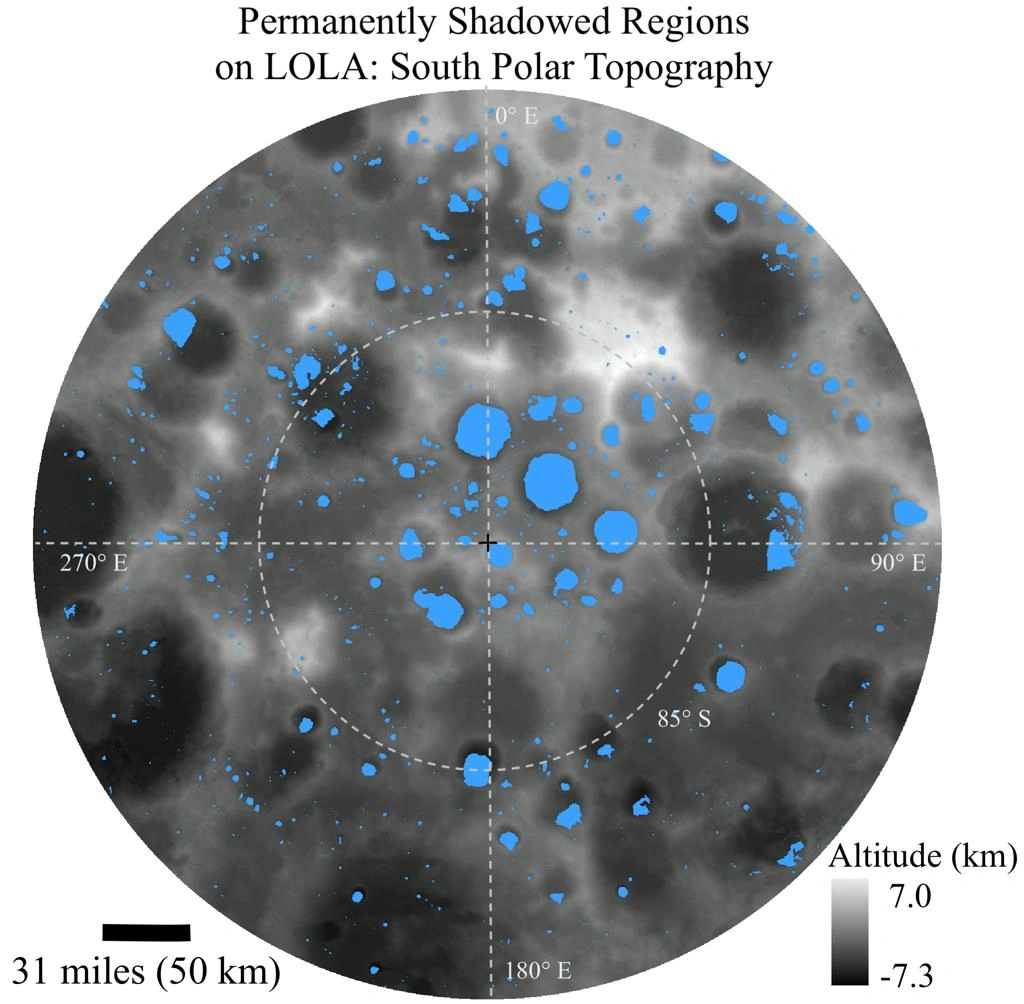
Unlike many other parts of the lunar surface, some regions near the south pole never receive direct sunlight. These areas are known as permanently shadowed regions because they remain in darkness throughout the lunar year.
Without sunlight, temperatures inside these craters can drop to extremely low levels, reaching around 25 Kelvin, or roughly minus 248 degrees Celsius.
Such extreme cold allows water ice to survive for billions of years without evaporating into space.
Because of these unique conditions, scientists believe permanently shadowed regions may contain significant amounts of frozen water preserved beneath the surface.
Chandrayaan-2’s Radar Played a Key Role
The discovery was made using Chandrayaan-2’s Dual Frequency Synthetic Aperture Radar, commonly known as DFSAR.
This advanced instrument was specifically designed to study both the lunar surface and the layers beneath it. Unlike optical cameras, radar systems can detect features that may not be visible through ordinary imaging techniques.
The radar operates using L-band and S-band frequencies, allowing researchers to analyze how signals interact with surface materials and possible underground structures.
By examining these radar reflections carefully, scientists can identify patterns that may indicate the presence of water ice.
Researchers Studied Rare Shadowed Craters
The study focused on a particularly interesting group of lunar craters known as doubly shadowed craters.
These craters are located inside already permanently shadowed regions, making them some of the coldest locations anywhere on the Moon.
Because they receive virtually no solar energy, they are considered ideal environments for preserving water ice over extremely long periods.
Lead researcher Rishitosh K. Sinha and his team used advanced radar analysis techniques to investigate these unusual formations.
Their work revealed radar signatures that appear different from surrounding lunar terrain, suggesting the possibility of buried ice deposits beneath the surface.
While the results do not yet provide direct proof of ice, they offer some of the strongest evidence so far that frozen water may exist below the lunar soil in these regions.
Why Water Ice Matters for Future Moon Missions
The discovery is important because water is one of the most valuable resources for long-term space exploration.
Transporting water from Earth into space is expensive and technically challenging. If astronauts can use resources already available on the Moon, future missions could become more sustainable and cost-effective.
Water ice can potentially be processed into drinking water, breathable oxygen, and hydrogen fuel for spacecraft.
This concept, known as in-situ resource utilization, is becoming a major focus for future lunar exploration programs.
Several countries and private companies are currently planning missions aimed at establishing a long-term human presence on the Moon.
Reliable water resources would make those ambitions far more realistic.
Growing Interest in Lunar South Pole Exploration
The Moon’s south pole has attracted increasing attention in recent years.
India’s Chandrayaan-3 mission successfully landed near the region in 2023, making India the first country to achieve a soft landing close to the lunar south pole.
Meanwhile, agencies including NASA, the European Space Agency, and other international partners are planning future missions focused on the same area.
Scientists believe the south pole could become the most important location for future lunar bases because of its potential access to water ice and other valuable resources.
Every new discovery from the region helps researchers better understand how future missions can operate there safely and efficiently.
What Happens Next
Although the radar observations are promising, scientists say additional studies will be needed to confirm the exact nature of the detected signals.
Future lunar missions equipped with advanced instruments or sample-return capabilities may eventually provide direct evidence of ice deposits beneath the surface.
Researchers will also continue analyzing Chandrayaan-2 data to identify other regions that may contain similar signatures.
The latest findings demonstrate how valuable Chandrayaan-2 continues to be years after its launch. Even today, the mission is helping scientists uncover new information about the Moon and improving our understanding of one of the most important destinations for future space exploration.
As interest in establishing a long-term human presence on the Moon grows, discoveries like these could play a major role in shaping the next generation of lunar missions.
Click Here to subscribe to our newsletters and get the latest updates directly to your inbox.